AI skill construction: 10 layers to reliable agents
The industry focus in 2026 shifts from testing agent performance to ensuring reliable behavior in production environments. The DEV Community framework distills this complex process into 10 progressive layers ranging from basic prompts to master-level execution. At Layer 1, a single SKILL.md file enables zero-code task completion through strict role definitions and behavioral rules. Layer 2 enhances capabilities by equipping the AI with reference materials, execution scripts, and template resources.
Specific evaluation criteria distinguish a basic prompt skill from a component skill capable of calling external tools. Understanding these distinct capability boundaries allows teams to accurately locate their current development stage. This walkthrough follows the layers where the framework does the real work: the zero-code baseline at Layer 1, resource directories at Layer 2, decision trees at Layer 3, then evidence cross-validation at Layer 7, human approval at Layer 8 and multi-skill orchestration at Layer 9. The method replaces guesswork with clear upgrade paths for skill-based execution that goes beyond conversational Q&A.
From Prompt Files to Structured Skill Execution
What a Skill Package Actually Contains
AI skill construction transforms large model applications from conversational Q&A into systematic skill-based execution. This evolution requires moving beyond simple prompting to implement a structured framework where agents execute set business workflows with precision. The DEV Community outlines ten progressive layers, ranging from pure-prompt Skills to master-level business closed loops, providing clear capability boundaries for developers. A Skill functions as a structured package containing instructions, code templates, resources, and verification logic that augments agent behavior at inference time without model modifications. Reliability stems from resource allocation rather than model ambiguity. Teams often underestimate the complexity gap between a single prompt file and an end-to-end business closed loop, leading to fragmented deployments.
Balance prompt engineering against structured resources carefully. A well-written prompt Skill may outperform a poorly coded Skill, yet complex tasks demand external references. Unlike simple chat interfaces, advanced layers require rule-based scoring to validate outputs against business constraints before execution. Skipping intermediate layers often results in brittle systems that fail when encountering edge cases outside their initial training distribution.
Layer 1 Prompt Files and Layer 2 Resource Directories
Layer 1 establishes a zero-code baseline where a single SKILL.md file directs the model. This "Zero-Code Starting Point" relies entirely on the large model's inherent language understanding to execute tasks without external tool calls. Developers define role definitions and output formats strictly within the prompt, avoiding code dependencies. A well-crafted prompt here often outperforms a poorly coded alternative by enforcing specific behavioral rules. However, this approach fails when tasks require knowledge exceeding the model's training cut-off or strict adherence to dynamic data schemas.
Layer 2 addresses these limits through "Structured Enhancement with Resources" by equipping the agent with external files. The architecture expands to include references/ for lookup tables, scripts/ for data processing, and assets/ for templates alongside the core definition. This shift moves the system from the AI figuring out answers to the AI consulting verified references. Industry analysis indicates that Agent Skills function as structured packages augmenting behavior at inference time without requiring model modifications. Microsoft's guidance suggests that while skills suit focused domains, workflows become necessary for multi-step business processes coordinating multiple agents. The cost is increased repository complexity; builders must now manage file versioning and script compatibility alongside prompt engineering. Failure to maintain these resources leads to context drift where the agent references outdated mapping tables.
Operationalizing Layer 2 requires treating prompts as configuration code rather than static text. Neglecting the scripts/ directory maintenance creates a hidden failure mode where formatting utilities break silently. Builders must validate that resource files remain synchronized with the primary skill definition to prevent hallucination.
Layer 3 Decision Trees Against One-Shot Prompts
Layer 3 introduces Multi-Step Decision Trees to handle tasks impossible to resolve in a single model call. This architecture shifts execution from one-shot guessing to procedural logic, where the system processes data step-by-step using prior outputs as subsequent inputs. Unlike Layer 1's static instructions, a Workflow Skill embeds conditional branches that dictate specific actions based on intermediate validation results. Microsoft's framework distinguishes these approaches by complexity, reserving workflows for multi-step business processes requiring external integrations rather than focused, single-domain queries handled by simple skills. The operational cost involves managing state across steps, as the system must persist context between the initial data validation and final insight generation phases.
The year 2026 marks a critical transition where industry focus shifts from testing raw agent performance to ensuring reliable behavior in production environments. Builders implementing these decision trees must account for increased latency introduced by sequential processing and potential failure points at each conditional branch. One-shot prompts offer speed but lack the structural rigidity required for deterministic business rules. The limitation of this procedural approach is its dependency on explicit step definitions; ambiguous logic in the decision tree causes immediate execution halts rather than graceful degradation.
Mechanics of Multi-Agent Orchestration and Security Controls
Phase-Orchestrator Protocols and Security-Guard Enforcement
The Phase-Orchestrator mandates a protocol where each Phase is executed by an independent sub-Agent, with JSON data passing between Phases. This structure shifts execution from a single monolithic context to distributed collaboration, optimizing complex workflows through multi-agent conversation, and marks what the framework calls the "watershed of Skill construction," the move from one agent executing every step to several agents collaborating on one task. By isolating reasoning layers, operators can evaluate component performance separately rather than debugging opaque end-to-end failures. Serialization overhead increases under this model, and rigid schema definitions become necessary for inter-phase communication.
A Security-Guard component intercepts these handoffs to enforce least privilege before any tool execution occurs. This guard validates permission configurations, data access scopes, and outbound actions against predefined policies, outputting risk ratings for every transaction. Unlike simple prompt filtering, this mechanism treats security as a structural gate rather than an advisory suggestion. Latency increases as validation steps add time to the total workflow duration, yet unauthorized data exfiltration stops at the gate.
| Feature | Single-Agent Workflow | Multi-Agent Orchestration |
|---|---|---|
| Context Scope | Monolithic, shared memory | Isolated per Phase |
| Failure Mode | Total context corruption | Contained Phase error |
| Security Model | Prompt-level constraints | Security-Guard enforcement |
| Complexity | Low coordination overhead | High serialization cost |
A compromise in one reasoning layer cannot propagate to the action layer without explicit clearance.
Parameterizing Business Logic via YAML Rule Engines
Storing evaluation criteria in YAML configuration files separates mutable business rules from immutable Skill logic. This architectural choice prevents the need to rewrite core prompts when scoring weights shift, a frequent requirement in flexible commercial environments. The mechanism functions by directing the Scoring-Engine to load external rule sets at runtime rather than relying on hardcoded values within the agent's definition.
| Feature | Hardcoded Logic | YAML Parameterization |
|---|---|---|
| Update Method | Modify Skill code | Edit config file |
| Risk Profile | High (prompt breakage) | Low (isolated changes) |
| Operational Overhead | Requires redeployment | Hot-reload capable |
Malformed rules might bypass Security-Guard checks entirely if the YAML schema lacks strict validation. Syntactic correctness does not guarantee semantic safety, creating a new failure mode where configuration and code separation introduces risk. Skills perform best on focused, single-domain tasks. Complex, rule-heavy scoring benefits from externalized control planes.
Risks of Hardcoded Rules and Single-Source Validation Failures
Hardcoding business logic directly into agent prompts creates brittle execution paths that fail when commercial conditions shift. Modifying embedded rules requires rewriting the core Skill definition, a process that risks breaking the underlying prompt engineering rather than simply updating a parameter. This approach violates the separation of configuration and code, forcing operators to treat mutable business policies as immutable software artifacts. The Scoring-Engine mitigates this by storing rules in external YAML files, allowing rule changes without redeploying the agent. Removing hardcoded constraints introduces a different failure mode if the input data lacks credibility. Relying on a single information source for critical decisions creates a high cost of misjudgment when that source contains errors or bias. A Skill without external verification acts like a car without brakes; the quicker it processes data, the greater the operational risk. Multi-agent architectures address this by requiring an Evidence-Chain that cross-validates claims against multiple records before execution. Framework specialization reflects this need, with distinct tools emerging for team orchestration versus flexible single-agent tasks. Systems that ignore this distinction cannot scale beyond simple, single-domain tasks.
| Risk Factor | Hardcoded Approach | Validated Approach |
|---|---|---|
| Update Mechanism | Code modification | Config edit |
| Data Source | Single input | Multi-source |
Building a Layer 3 Workflow in Practice
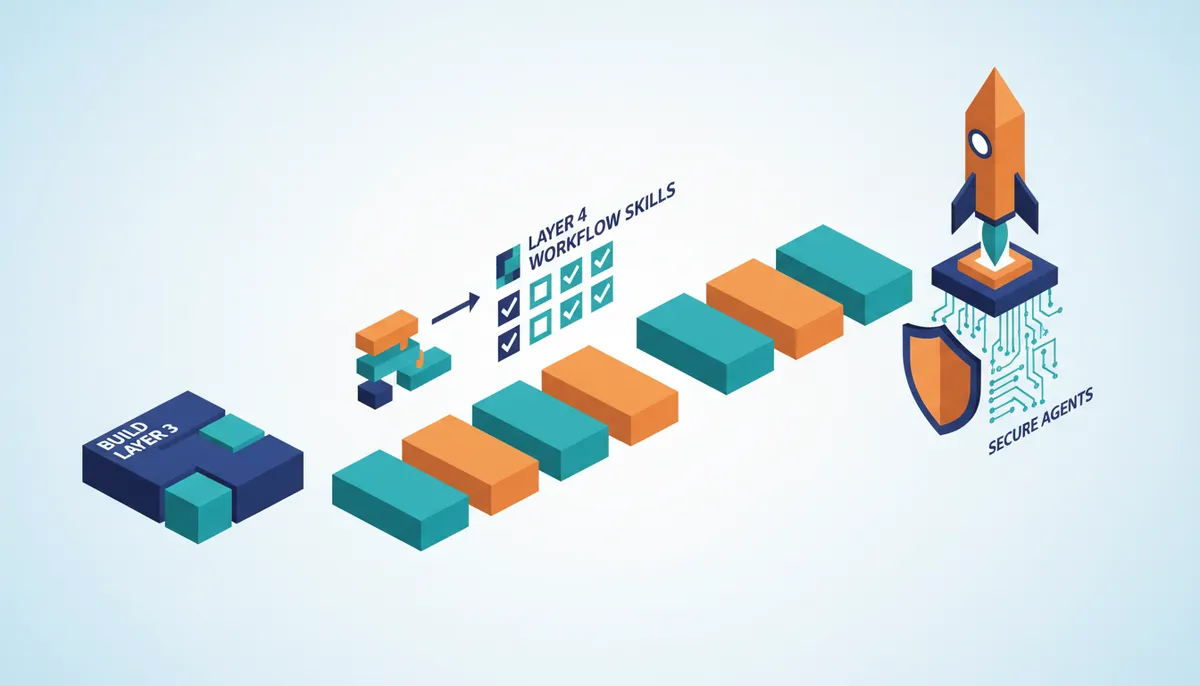
Building a Layer 3 workflow starts with the decision tree itself. Builders must define explicit prerequisites and deliverables for every node in the sequence. A data analysis skill might validate inputs before calculating statistics, then detect anomalies only if variance exceeds thresholds. Implementation requires breaking complex objectives into ordered sequences with clear processing logic. This approach enforces a rigid execution path that prevents the model from skipping critical safety checks or analysis phases. Hardcoded sequences reduce flexibility when business rules fluctuate frequently. Operators must balance the stability of set paths against the agility needed for flexible environments. The cost of this rigidity is acceptable when audit trails and consistent output formats are mandatory. AI Agents News recommends this pattern for high-compliance domains where procedural adherence outweighs conversational fluidity.
Operationalizing Business Closed Loops with Validation and Approval
Layer 7: Evidence From Two Independent Sources
Layer 7 validation extracts evidence to infer root causes instead of accepting surface data. This Multi-Source Evidence Cross-Validation mechanism functions within the 'Ten Layers' systematic framework for AI skill construction, moving development from simple prompts to strong business closed loops. A technical Skill obtains information from at least two independent data sources, applies explicit cross-validation logic, and generates outputs that include confidence scores. The system analyzes why sources conflict rather than performing simple aggregation, distinguishing between data latency artifacts and genuine operational anomalies. Isolating information silos often leads to misjudgment, and this approach mitigates that risk. Rigorous validation introduces latency, creating a challenge for real-time systems waiting on secondary sources to confirm primary alerts. Builders balance verification depth against the speed requirements of specific business closed loops. Mature AI skills transition from reactive prompting to proactive evidence synthesis, forming a secure foundation for autonomous execution.
Layer 8: Human Confirmation Before High-Risk Actions
High-risk operations mandate human confirmation within a structured risk classification system. Layer 8 implements 'Human-in-the-Loop Risk Control' specifically for these high-risk operations, shifting execution logic from automatic action to a mandatory "AI request → human confirmation → execution" closed loop. Agents act autonomously in lower-level tasks, yet this layer intercepts actions carrying significant business liability. Complex workflows requiring approval necessitate a workflow architecture rather than a simple skill definition. Operators configure the system to assess risk levels dynamically so only low-risk operations bypass human review. Enforcing strict approval gates reduces error rates but introduces latency into time-sensitive workflows. Alert fatigue occurs when risk classification logic is too broad, whereas high-stakes errors slip through if the logic is too narrow. Rule-based scoring must be precise and auditable, not heuristic. Human oversight serves as necessary protection for business security rather than indicating a lack of trust in the model. Teams define clear boundaries for high-risk events to prevent the approval process from becoming a bottleneck. Automation scales safely under human supervision within this resilient system.
Layer 9: What an Orchestration Benchmark Must Show
Validate that unified orchestration links multiple base Skills to complete end-to-end processes from single natural language input. Layer 9 is the 'Multi-Skill Orchestration Benchmark,' focusing on orchestrating multiple Skills into an end-to-end pipeline. This benchmark confirms the transition from isolated tools to a cohesive business closed loop system.
| Requirement | Validation Target |
|---|---|
| Skill Count | Orchestrates multiple distinct base Skills |
| Entry Point | Single natural language input triggers pipeline |
| Architecture | Unified orchestration layer manages handoffs |
Complexity dictates using workflows for multi-step processes rather than forcing single-domain Skills to handle broad coordination. Agent orchestration patterns enable manager-style configuration, yet the cost is increased interface protocol rigidity. Error propagation represents a common failure mode where a fault in an early Skill corrupts downstream aggregation without clear confidence scoring. Builders treat rule-based scoring as a mandatory gate, not an optional metric, to evaluate pipeline integrity before deployment. The system functions as a unified business entity rather than a fragile chain of independent prompts.
About
Priya Nair serves as AI Industry Editor at AI Agents News, where she tracks the strategic evolution of autonomous systems and platform capabilities. Her daily coverage of product launches from vendors like Devin and Cursor provides unique insight into the industry's shift from simple conversational interfaces to structured skill execution. This article's framework directly addresses the gap Nair observes between basic prompting and end-to-end business workflows, a challenge frequently faced by the engineering leaders in her audience. By analyzing market moves and technical limitations across the system, she identifies the specific layers required to mature from experimental prompts to reliable business closed loops. Her reporting rigor ensures this systematic approach is grounded in current agent architecture realities rather than hype. At AI Agents News, a hub dedicated to technical founders and engineers, Nair uses her deep understanding of orchestration and tool use to guide builders through the complex transition toward reliable, production-ready AI skills.
Conclusion
Scaling AI skill construction reveals that error propagation becomes the primary bottleneck once pipelines exceed three distinct handoffs. Unified orchestration enables complex workflows, but the operational cost shifts from prompt engineering to maintaining auditable scoring gates that keep an upstream fault from corrupting downstream aggregation, and teams relying on heuristic confidence metrics watch reliability degrade as volume rises.
That is why the layers are ordered the way they are. A prompt file, a resource directory and a decision tree each buy a specific capability; evidence cross-validation, human approval and multi-skill orchestration each buy a specific guarantee. Rule-based scoring is the gate between the two halves: precise and auditable rather than heuristic, mandatory rather than optional. Skip it and the pipeline scales its own errors.
Frequently Asked Questions
Skipping resource files causes context drift where agents reference outdated mapping tables. You must manage Agent Skills as structured packages to prevent silent formatting utility failures during dynamic data schema execution.
You need Layer 3 when tasks cannot be resolved in a single model call. This requires breaking complex jobs into ordered step sequences with clear conditional branches for data passing between steps.
A well-crafted prompt Skill often outperforms a poorly coded alternative by enforcing strict behavioral rules. However, this zero-code approach fails when tasks require knowledge exceeding the model training cut-off limits.
The industry focus shifts from testing performance to ensuring reliable behavior in production environments. Teams must adopt structured execution frameworks rather than relying on conversational Q&A patterns for business workflows.
Skipping intermediate layers results in brittle systems that fail on edge cases outside initial training. Builders must follow clear upgrade paths to avoid fragmentation between simple prompts and closed loops.
References