AI agents replace passive bots with real workflows
With 80% of enterprises already deploying production AI agents by Q1 2026, the era of passive conversation is dead. The central thesis is clear: we are witnessing a fundamental pivot from AI that talks to AI that acts, transforming software from a query-response loop into an autonomous workflow engine.
Gartner predicts that 40% of enterprise applications will embed task-specific agents by year-end, a massive leap from less than 5% in 2025. (Gartner's strategic predictions for 2026) The architectural chasm is easy to state and expensive to ignore: a chatbot answers, while a goal-driven agent takes an instruction like "research competitors" and runs it to completion without step-by-step handholding. The shift is not merely about quicker answers but about delegating outcomes, marking the moment AI agents become the next substantial computing platform.
Defining the AI Agent as an Autonomous Workflow Engine
The operative difference is where the loop stops: a chatbot stops at the answer, an agent stops at the goal, and the steps in between run without a prompt. That is why agent embedding already reads as the default rather than an experimental pilot: the 80% counts agents that shipped into production systems, not prototypes that demoed well. Autonomous systems reduce manual orchestration overhead notably, though pointing a generalist model at a specialized task trades that saving back for latency and context errors. Governance remains the primary constraint because autonomous actions can drift from intended business logic without strict goal parameters.
The defining characteristic remains the ability to act. As ChatGPT hit a billion monthly active users by June 2026, the market focus shifted from conversation volume to autonomous action. Network architects now face a requirement for higher reliability in downstream API dependencies. Agent failures cascade into broken business processes rather than just incorrect answers.
Real-World AI Agent Workflows: From ChatGPT Queries to Klarna Savings
Klarna's autonomous system saved $60 million by executing the workload of 853 employees, proving AI agents act rather than converse. This operational shift replaces passive query resolution with active task completion. The distinction is operational: the agent owns the task end to end and reports only when the goal is met. Rapid deployment introduces a tension between efficiency gains and critical thinking skill atrophy. Operators must balance automated execution with human oversight to prevent decision-making degradation. The cost of unchecked automation is measurable in lost analytical capability across teams relying solely on autonomous workflows.
Infrastructure must support high-frequency, low-latency tool access for these agents. Unlike static web traffic, agent-driven flows require persistent state and context awareness across multiple backend systems. Failure to architect for this goal-directed behavior results in broken chains of execution.
The Economics of the Shift: $2.9 Trillion, Displaced Hours and Build Costs
The economic implication of the move from talking to acting is severe, with projected annual U.S. Value reaching $2.9 trillion by 2030 as automation scales. Organizations must distinguish between tools that talk and those that act to capture this value.
The limitation of conversational models becomes clear when analyzing labor displacement potential. Reports suggest 27% of current work hours face automation by 2030 through agentic systems. This shift forces a reevaluation of enterprise architecture roles. Eva Jaidan identifies enterprise architects as the guardians of AI agents, tasked with mapping IT systems to business capabilities. Unlike static chatbots, agents require flexible permission structures to function safely. A tension exists between deployment speed and system complexity. Basic projects cost $50,000 to $100,000, while custom large-scale systems run far higher. This cost structure prevents low-maturity organizations from skipping core work. The transition demands rigorous governance rather than simple prompt engineering. Without set goals, autonomous systems fail to deliver measurable returns.
Architectural Differences Between Conversational Bots and Goal-Driven Agents
The Decision-Making Loop in Autonomous AI Agents
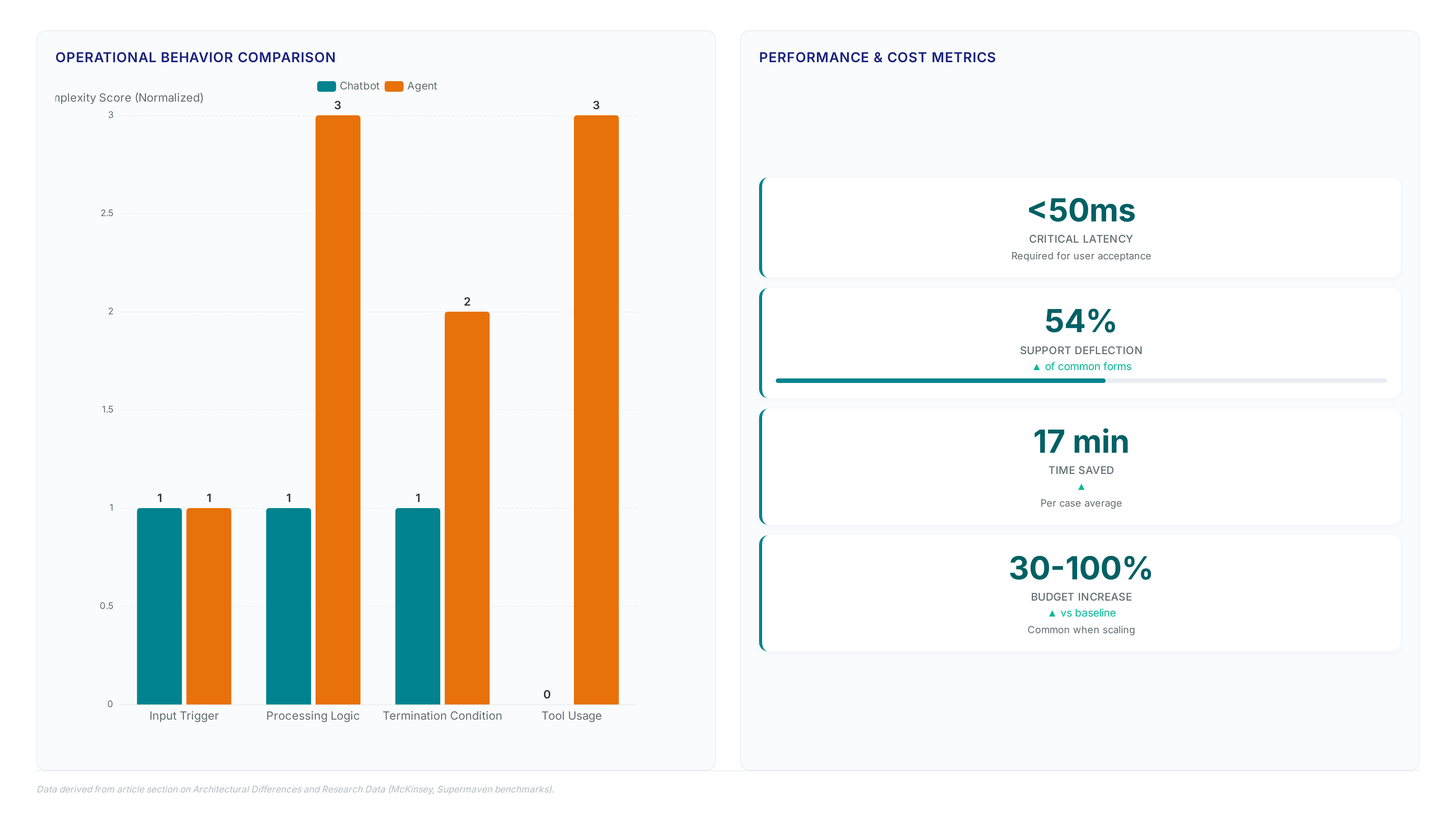
Autonomous AI agents execute a continuous plan-act-observe loop to achieve goals rather than responding linearly to prompts. This mechanical divergence means an agent dynamically selects tools and accesses information based on intermediate results, not input text. Unlike chatbots that terminate after a single turn, these systems maintain state across multi-step workflows. However, this autonomy introduces latency risks absent in static conversational models, because every plan-act-observe cycle adds a round trip before the agent produces anything the user can see.
| Phase | Chatbot Behavior | Agent Behavior |
|---|---|---|
| Input | Receives prompt | Receives goal |
| Processing | Generates token stream | Plans, executes, observes |
| Termination | Stops at EOS token | Stops at goal completion |
| Tool Use | Rare or manual | Autonomous and iterative |
The operational cost of this flexibility is the necessity for rigorous agent lifecycle management to ensure instances decommission immediately after task fulfillment. Failure to enforce strict lifecycle boundaries leads to resource exhaustion as idle agents consume compute while awaiting non-existent triggers. This constraint forces architects to balance goal-directed persistence against infrastructure efficiency.
ServiceNow and JPMorgan: Automating Workflows with AI Agents
ServiceNow deployments now deflect roughly 54% of common support forms, saving 12 to 17 minutes per case through autonomous workflow execution. This metric proves goal-directed task automation replaces manual triage in IT service management. Unlike conversational bots that require step-by-step prompts, these agents access backend databases and execute multi-step resolutions independently. The architectural shift requires Agent-to-Agent communication protocols to maintain state across complex enterprise systems without human intervention. JPMorgan operates over 450 AI use cases daily, using systems like COIN to automate loan agreement reviews that previously consumed thousands of labor hours.
The limitation of current deployments often stems from legacy API constraints rather than agent logic failures. Successful integration demands rigorous testing of tool-use permissions to prevent unauthorized actions during autonomous planning phases.
Hidden Costs: Budget Overruns in AI Agent Implementation
Initial estimates for autonomous systems often fail because hidden costs related to data preparation can double the total budget. This financial gap emerges because AI agents require persistent state management and complex tool integration that conversational bots do not. While a chatbot simply retrieves information, an agent must plan tasks and execute multi-step workflows, demanding significantly higher compute and storage.
| Cost Driver | Conversational Bot | Autonomous Agent |
|---|---|---|
| Data Prep | Low | High |
| Integration Depth | API Call | Stateful Orchestration |
| Governance Scope | Prompt Filter | Tool Access Control |
| Failure Recovery | Retry Prompt | Rollback Workflow |
Organizations skipping this step face unmanaged risks as agents interact with external systems. Costs climb again when teams underestimate the complexity of securing these flexible workflows against injection attacks or logic errors. Operators must treat budget planning as a technical constraint, not a financial one: underfunding the integration layer leaves systems that cannot recover from partial failures, and the value of automation disappears once the cost of keeping it safe exceeds the labor it replaces. Governance frameworks must include human-in-the-loop controls to verify actions before they trigger downstream financial events. The window for early-mover advantage narrows as 23% of organizations already scale these technologies.
About
Sofia Berg serves as Research Editor at AI Agents News, where she specializes in translating complex multi-agent research into actionable insights for engineers. Her daily work involves rigorously evaluating agentic frameworks and benchmarking autonomous systems against standards like SWE-bench, making her uniquely qualified to analyze the critical shift from conversational chatbots to task-executing AI agents. While chatbots merely process language, Berg's expertise lies in dissecting how agents apply tool use and orchestration to complete multi-step workflows independently. At AI Agents News, she constantly reviews how systems like AutoGen and LangGraph enable this transition from talking to acting. This article reflects her direct experience separating technical reality from market hype, offering builders a clear-eyed view of why autonomous execution represents the next frontier in enterprise AI adoption rather than simple dialogue expansion.
Conclusion
The pivot is already priced. Klarna's $60 million and ServiceNow's roughly 54% form deflection are not conversation metrics; they are what a system produces when it owns a task end to end and reports only on completion. That is the capability 80% of enterprises put into production by Q1 2026.
The cost side decides who keeps it. Basic projects run $50,000 to $100,000 and data preparation alone can double the total, because an agent needs persistent state, tool access control and a rollback path that a chatbot never required. Fund the integration layer and the automation survives its first partial failure. Fund the prompt and you have a bot holding permissions.
Frequently Asked Questions
Klarna's autonomous system saved $60 million by executing workloads. This proves agents act rather than just converse. By Q1 2026, 80% of enterprises had shipped at least one embedded agent into production, driving similar efficiency gains.
Gartner predicts 40% of enterprise applications will embed agents by year-end. This represents a massive jump from less than 5% in 2025. The shift moves infrastructure from passive query resolution to active task completion rapidly.
The loop, not the vocabulary. A chatbot receives a prompt, generates a token stream and stops at the end-of-sequence token; an agent receives a goal, then plans, executes and observes in a cycle it repeats until the goal is met, selecting tools from intermediate results rather than from the input text.
A wrong chatbot answer stops on the screen; a wrong agent action has already touched a backend system, so the failure arrives as a broken business process. Recovery differs for the same reason: a bot retries the prompt, an agent needs a rollback path for work it has already performed.
ChatGPT reached a billion monthly active users by June 2026, but conversation volume stopped being the number that matters. The comparable measure for agents is completed work: roughly 54% of common support forms deflected at ServiceNow, 12 to 17 minutes saved per case, $60 million at Klarna.