LangChain framework: Swap models instantly
Over 1000 integrations let you swap models and tools without rewriting application code, and composable middleware hooks keep that neutrality customizable rather than fixed. Neutrality is the design goal of the framework, not a side effect of it.
Connecting to providers like OpenAI, Anthropic, and Google takes under 10 lines of code. The real value emerges when you need to change underlying components instantly. LangGraph provides the durable runtime production agents require, delivering built-in persistence, checkpointing, and rewind capabilities that standard scripts lack. LangSmith integrates to debug every agent decision and evaluate changes before deployment.
Middleware compresses long conversations or injects human-in-the-loop approval flows without altering core logic. Running the ReAct pattern on a persistent backend is what keeps agents adaptable as the system evolves, and the LangChain Academy Course covers these pre-built architectures free of charge.
The Role of LangChain as a Neutral open-source Agent Framework
Why Neutrality Is the Design Goal
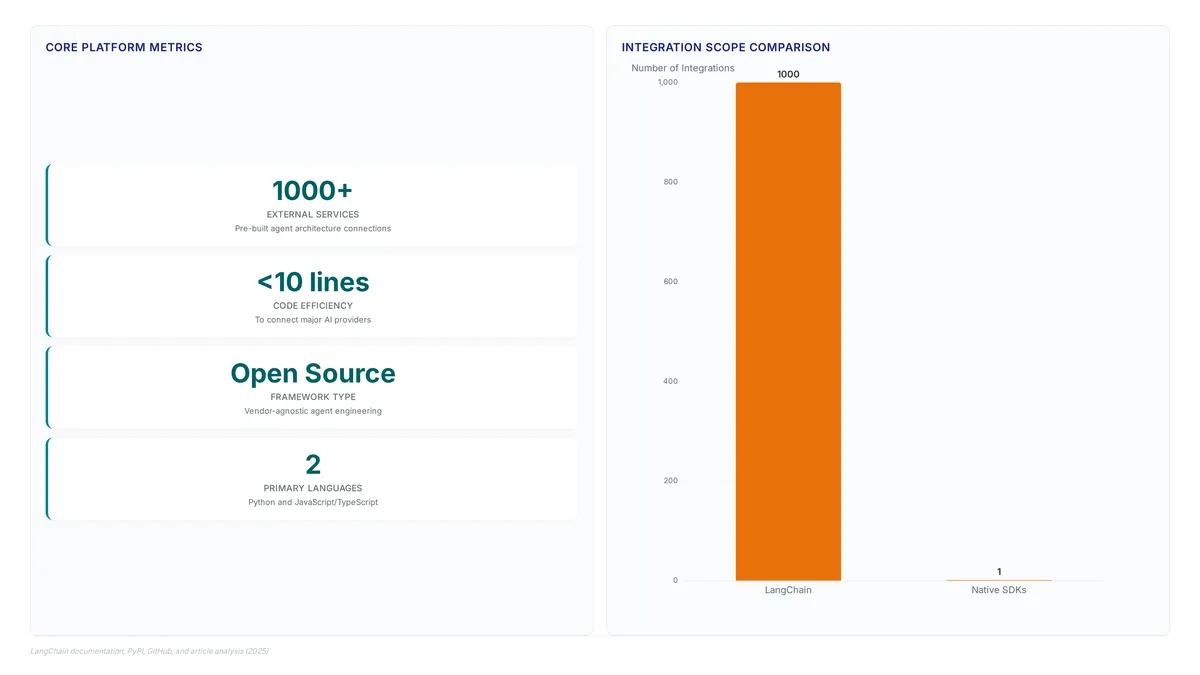
LangChain merges pre-built agent architecture with a vast library of tool integrations as an open-source framework. It functions as an agent engineering platform designed to stop vendor lock-in through strict neutrality. The system connects to 1000+ integrations, letting teams exchange models, databases, and tools without touching core application code.
Engineers must judge frameworks by runtime durability, not just connector counts. Rapid template deployment often clashes with the need for custom middleware. Templates speed up early builds, yet complex enterprise needs usually require composable hooks for data sanitization or human-in-the-loop approval. Users modify agent behavior via middleware without redoing core logic.
Framework neutrality ensures persistence mechanisms and observation layers stay separate. Operators can migrate underlying large language models without changing orchestration logic or state strategies. This split guarantees the durable runtime keeps checkpointing and rewind features regardless of the chosen vendor. Engineers must value this modularity for long-lived agent deployments where system volatility poses a real risk. Future-proofing a stack means confirming the framework treats model providers as swappable resources rather than fixed dependencies.
Building Adaptive Agents with ReAct Patterns and Middleware
The create_agent function sets up ReAct patterns on LangGraph's durable runtime to handle tool usage and reasoning loops. This setup lets developers build agents with pre-made architectures while keeping state persistence intact during interruptions. The framework links to providers like OpenAI and Anthropic with little boilerplate, supporting quick changes to agent logic.
Middleware hooks handle customization by intercepting execution steps without changing core application code. Operators use these hooks to force human-in-the-loop approval before sensitive tool calls or to shrink conversation history for improved token efficiency. This method keeps business logic apart from cross-cutting concerns like data sanitization.
| Feature | Implementation Method | Operational Benefit |
|---|---|---|
| Reasoning Loop | create_agent utility |
Standardizes ReAct pattern usage |
| State Management | Durable runtime | Ensures persistence across failures |
| Behavior Extension | Middleware hooks | Adds approval layers without refactoring |
Agent autonomy often conflicts with safety needs. Unrestricted tool access invites accidental actions, while too much gating adds complexity. Middleware fixes this by enforcing granular policies at runtime instead of compile time. Builders must match safety check depth to their specific use case requirements.
Adopt this pattern when adaptable agents need strict operational guardrails: custom middleware logic survives a change of model or tool underneath it, which is what makes testing across providers cheap.
Inside the Durable Runtime and Persistence Mechanisms of LangGraph
LangGraph Durable Runtime Checkpointing and State Persistence
LangChain runs on LangGraph's durable runtime, which provides agents with built-in persistence, rewind, checkpointing, and human-in-the-loop support. This engine serializes agent state after every step, storing snapshots that survive process restarts or network failures. Developers can rewind execution to any prior checkpoint to inspect intermediate reasoning or correct tool outputs without re-running the entire conversation. The mechanism relies on explicit state schema definitions where the runtime manages serialization automatically.
Enabling checkpointing introduces latency overhead on every token generation step. High-frequency tool calls in tight loops may accumulate serialization delays, requiring builders to tune checkpoint intervals for latency-sensitive workflows. This constraint favors reliability over raw speed so long-running agents do not lose context during infrastructure hiccups.
The architecture separates computation from storage, allowing operators to plug in different backends for state management while keeping agent logic unchanged. Such decoupling means teams can scale state storage independently from compute resources, a necessity for agents managing thousands of concurrent conversations. The rewind capability specifically enables human-in-the-loop workflows where supervisors pause execution, modify state, and resume processing.
Human-in-the-loop pauses run on the same machinery: operators configure interrupt nodes that halt execution at set boundaries before sensitive or irreversible tool calls, and the runtime holds the full execution context in persistent storage while it waits. Builders therefore treat agent conversations as durable transactions rather than ephemeral requests, correcting a single bad function call without discarding the entire conversation history, and multi-day workflows wait on external events without losing context.
Checklist for Validating Agent State Persistence and Recovery
Template-based development assumes a durability nobody has verified. Three checks establish it:
- Confirm the durable runtime writes snapshots to persistent storage before executing external functions.
- Test rewind capabilities by forcing a crash mid-conversation and verifying context restoration.
- Validate that interrupt nodes preserve full execution history while awaiting human approval.
| Validation Target | Failure Mode | Recovery Requirement |
|---|---|---|
| State Schema | Missing keys | Strict typing enforcement |
| Storage Backend | Write latency | Async commit verification |
| Checkpoint ID | Collision | Unique identifier generation |
Skipping these checks risks total conversation loss if the hosting container terminates unexpectedly. Unlike simple in-memory caches, the LangGraph engine requires explicit configuration to survive infrastructure volatility. Engineers must treat state serialization as a primary dependency rather than an optional feature. AI Agents News recommends testing failure scenarios under load to expose serialization bottlenecks early.
Building and Debugging Agents with LangSmith and Middleware Extensions
LangSmith Agent Observability and Decision Debugging
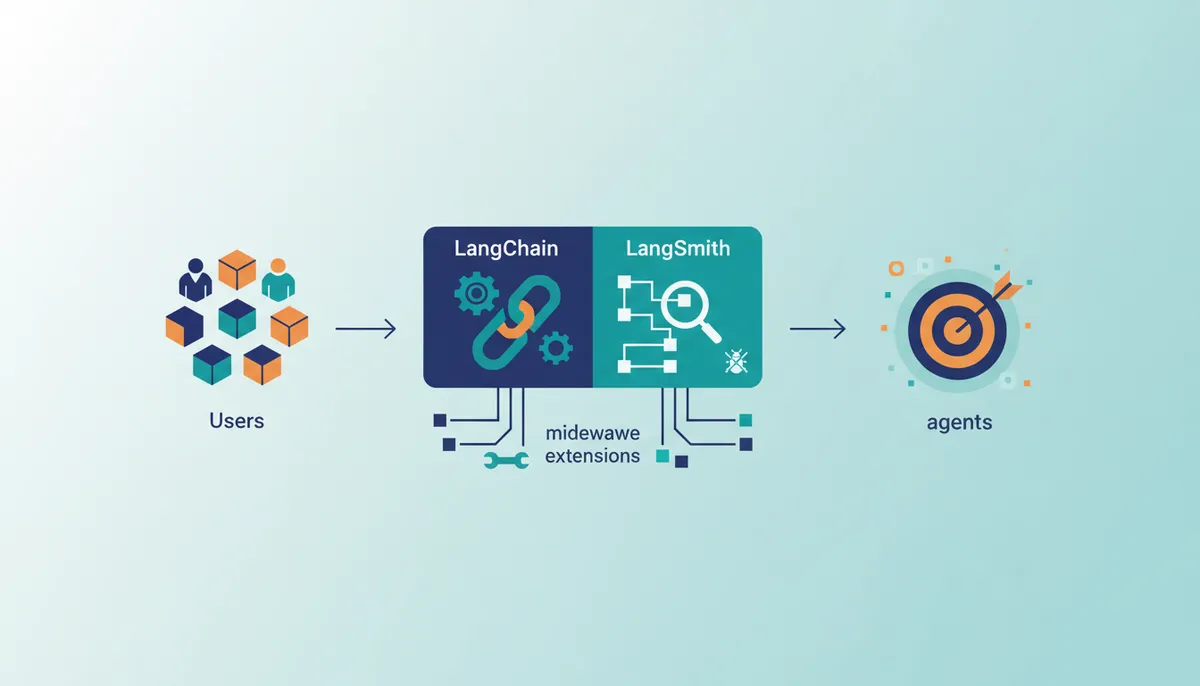
LangSmith operates as the dedicated platform for agent observability, evaluation, and deployment inside the LangChain system. A single environment variable links the open-source framework to this agent engineering platform, enabling developers to debug every agent decision and eval change instantly. Detailed traces capture tool calls, model outputs, and state transitions for deep inspection. Engineers run offline evals on curated datasets while simultaneously testing against live production traffic. Such visibility turns raw execution logs into actionable data for improving agent reliability. Teams evaluate specific changes after updating prompts or swapping underlying models without losing historical context. Production environments become manageable through this depth of data, offering clear insight into system behavior during complex workflows.
Implementing Middleware for Data Compression and Privacy
Engineers extend agent behavior using middleware hooks that compress long conversations and strip sensitive data, avoiding any need to rewrite core logic. Simple, composable hooks implement these features efficiently. This architecture lets teams insert processing layers that treat context management as distinct from reasoning logic. Separating model costs from the framework itself grants granular control over token usage and privacy compliance.
These extensions deliver specific capabilities:
- Compression shrinks conversation history to fit strict context windows.
- Redaction removes personally identifiable information from all inputs and outputs.
- Approval places human-in-the-loop validation gates around critical actions.
- Filtering blocks harmful content before it reaches the model layer.
The pre-built agent architecture supports such modifications via simple interfaces that require no forked repositories. Hardcoding logic into prompts often fails to enforce consistent policy across different models, whereas middleware guarantees uniform governance. This design future-proofs the stack as AI advances, allowing teams to swap underlying models while retaining established controls. Builders adapt quickly to new regulatory demands without rewriting the entire application layer.
Strategic Advantages of LangChain for Future-Proof AI Development
The Cost of Staying Vendor-Agnostic
Neutrality is not free. Teams must actively manage version compatibility across diverse integrations rather than relying on one vendor's update cycle, which is the tax paid for decoupling orchestration from vendor-specific runtimes and staying clear of the lock-in found in closed alternatives like the OpenAI Agents SDK or Google ADK. Organizations prioritizing long-term adaptability over immediate convenience gain the most, separating business logic from transient model APIs. AI Agents News recommends this pattern for teams requiring strict control over deployment topology and data boundaries.
What create_agent Leaves to the Engineer
The create_agent function composes an agent from distinct models, tools, prompts, and middleware components rather than forcing a monolithic design. What it does not do is hide the seams.
Separating orchestration logic from execution costs creates a distinct architectural win, keeping model and tool fees separate from the framework itself. Modularity introduces coordination overhead; engineers must explicitly define tool use policies and error handling strategies that opaque wrappers often hide by default. Higher-level packages like Deep Agents, built directly on this foundation, show how the framework supports layered abstraction without losing low-level control. Operators should deploy this pattern when application requirements demand frequent model iteration or complex multi-agent coordination exceeding simple chain-of-thought patterns. For teams evaluating whether to use LangChain for agent development, the decision rests on needing long-term adaptability versus the immediate simplicity of single-vendor solutions. AI Agents News recommends this approach for production systems requiring durable state management and observability integration.
LangChain Versus 13 Fragmented Competitors and Native SDKs
A March 2025 analysis identified 13 direct competitors, including CrewAI, AutoGen, and Semantic Kernel, creating a fragmented competitive environment for builders. LangChain functions as a neutral orchestration layer rather than a proprietary wrapper for specific models, unlike rigid vendor-tied alternatives. This distinction allows engineers to swap underlying components without rewriting application logic, a flexibility absent in native SDKs from substantial cloud providers.
| Feature | LangChain | Native Vendor SDKs |
|---|---|---|
| Model Support | Any model or tool | Proprietary models only |
| Architecture | Modular, composable hooks | Rigid, monolithic design |
| Runtime | Durable state persistence | Ephemeral session limits |
| Integrations | 1000+ neutral integrations | Limited to vendor services |
Competitors like Google ADK and Microsoft Agent Framework remain distinct entities tied to their respective clouds, whereas LangChain emphasizes integrations for any model to ensure portability. Strategic advantage lies in this vendor neutrality, protecting infrastructure investments when model performance shifts or pricing changes. The catalog is better treated as an inventory needing regular audits than as a static promise, since avoiding lock-in costs the time spent keeping composable hooks and middleware logic current.
About
Priya Nair serves as the AI Industry Editor at AI Agents News, where she tracks the business dynamics and product evolution of autonomous systems. Her daily work involves rigorous analysis of platform moves, funding rounds, and technical launches across the agent system, making her uniquely qualified to dissect the LangChain framework. While her reporting often focuses on market shifts, this deep immersion in agentic architectures allows her to evaluate how core infrastructure like LangChain's ReAct patterns and LangGraph runtime directly impact engineering decisions. At AI Agents News, an independent hub for technical founders and engineers, Priya applies her expertise in framework verification to explain LangChain's 1000+ integrations without vendor bias. Her coverage connects high-level industry trends to the practical realities of building durable, neutral agent stacks, ensuring readers understand not just what the framework does, but how its design principles prevent vendor lock-in in a rapidly changing market.
Conclusion
Scaling agent systems reveals that the true bottleneck shifts from model capability to the operational overhead of managing fragmented tool connections. Native SDKs offer rapid initial setup and create a hidden debt where every model update or provider switch demands significant code refactoring, whereas a durable runtime under a neutral orchestration layer keeps that switch a configuration change.
That is the trade the framework asks for: more initial configuration and a catalog of connectors to keep current, in exchange for a stack where the model provider is a swappable resource rather than a fixed dependency. For a disposable prototype the trade is a bad one. For anything meant to survive its next provider change, it is the entire point.
Frequently Asked Questions
The runtime serializes state after every step, so the snapshot outlives the process. You rewind to a prior checkpoint and resume from there instead of replaying the conversation, which is also how a hallucinated reasoning step gets undone.
Middleware hooks intercept execution steps, and interrupt nodes halt the run at set boundaries before a sensitive or irreversible tool call. Core application logic stays untouched, and the execution context sits in persistent storage while the approver takes their time.
LangSmith traces every tool call, model output, and state transition, and a single environment variable connects it to the framework. Offline evals run on curated datasets alongside tests against live production traffic.
Yes, a JavaScript version exists alongside the primary Python implementation. This dual support allows teams using different languages to build agents with the same neutral open-source framework.
The create_agent utility standardizes the ReAct pattern on the durable runtime. It composes the agent from models, tools, prompts, and middleware instead of hiding them, which leaves tool-use policies and error handling for the engineer to define explicitly.
References