Agent testing needs an LLM evaluator, not static scripts
With 276 commits logged by awslabs, the Agent Evaluation framework proves that testing virtual agents requires an LLM-driven evaluator agent, not static scripts. This architecture shifts validation from checking predefined rules to assessing an agent's actual reasoning and tool selection capabilities in real-time.
The framework distinguishes itself by orchestrating multi-turn dialogues where the system actively challenges a target agent rather than simply polling endpoints. Unlike traditional methods that rely on fixed inputs, this approach uses generative AI to simulate unpredictable user behaviors and complex conversation flows. The codebase, which is 96.2% Python according to repository data, natively supports Amazon Bedrock, Amazon Q Business, and Amazon SageMaker while allowing users to integrate custom agents.
The reasoning assessment layer validates decision-making logic rather than response text, which is what makes a failure traceable to a component instead of to the stack as a whole. Embedded in CI/CD pipelines, these checks run on every commit, and user-defined hooks add rigorous integration testing alongside the conversational analysis.
The Role of Generative AI in Modern Virtual Agent Testing
Defining the Evaluator Agent in Generative AI Testing
Stop treating your agent like a REST endpoint. An autonomous LLM, the evaluator, engages a target agent in multi-turn dialogue to validate responses dynamically. This isn't about matching strings against a fixed expectation; it is a generative AI-powered framework that creates test cases and scores outputs in real-time. By simulating diverse user interactions, the system assesses complex reasoning and tool use that simple output checks miss entirely.
There is a cost. Latency overhead appears when deploying such flexible evaluation, a burden absent in lightweight assertion checks. Throughput may decrease as concurrency scales because running an LLM judge alongside the target agent incurs computational cost. Depth of insight competes with execution speed during large-scale regression runs for builders. Yet, the framework implementation is predominantly Python, constituting 96.2% of the codebase, ensuring extensibility for custom hooks.
Operators define specific integration tasks while the evaluator manages conversation state. Continuous validation occurs within CI/CD pipelines without manual intervention thanks to this architecture. Testing regimes adapt to agent behavior changes rather than failing on rigid criteria. Detailed measurement of agent capability replaces the binary pass/fail gate.
Orchestrating Multi-Turn Conversations in CI/CD Pipelines
Context retention across long dialogue sequences breaks single-prompt checks. The awslabs agent-evaluation framework solves this by orchestrating concurrent, multi-turn conversations to validate stateful agent behavior. An evaluator agent manages session state while interacting with a target system within this generative AI-powered framework. Teams expedite the time to delivery while maintaining the stability of agents in production environments by integrating these checks into CI/CD pipelines.
Built-in support exists for popular AWS services, specifically Amazon Bedrock, Amazon Q Business, and Amazon SageMaker. Technical specifications for top frameworks now explicitly include support for multi-turn conversations, requiring the maintenance of session state during evaluation runs. Agent logic depending on historical context rather than isolated inputs demands this approach from operators. Running concurrent evaluators consumes more resources than static assertion tests, presenting a key limitation. Infrastructure scaling must account for the parallel load generated by simultaneous dialogue simulations. Builders facing complex reasoning chains benefit most from this flexible validation method. Simple query responders may not require such overhead.
Static Rule-Based Testing Versus Reasoning Layer Assessment
Fixed string matches validate nothing when agent logic diverges from rigid scripts. Static rule-based testing catches syntax errors but misses failures in complex planning or tool invocation. A generative AI-powered framework addresses this gap by deploying an evaluator to orchestrate multi-turn dialogues. Decision-making handled by the reasoning layer gets isolated from the action layer responsible for function calling within this architecture.
Engineers pinpoint whether a failure stems from poor planning or incorrect tool execution by evaluating these components independently. Static checks cannot distinguish between a logic error and a transient API fault, often leading to ambiguous debug sessions. Running an LLM evaluator adds latency compared to simple assertion checks, representing a clear constraint. Diagnosing why an agent hallucinated a tool argument remains impossible without separating these layers. Granular visibility takes priority over raw speed for teams maintaining stability in production systems.
Inside the Architecture of Reasoning and Action Assessment
Evaluator Agent Orchestration Mechanics
A public repository named agent-evaluation hosted by the awslabs organization on GitHub implements an LLM evaluator that dynamically orchestrates multi-turn conversations with a user-set target agent. Static rule-based testing cannot match this architecture because it initiates independent reasoning threads to assess agent behavior during execution rather than analyzing fixed logs.
- The evaluator initializes a conversation context and sends the first prompt to the target.
- Upon receiving a response, the system evaluates the output against set criteria before generating the next turn.
- This loop continues concurrently across multiple threads to stress-test stability and consistency.
This flexible approach contrasts with end-to-end conversational tests offered by other tools, as it separates the evaluation of reasoning layers from action execution to pinpoint specific failure modes.
| Feature | Static Testing | Evaluator Orchestration |
|---|---|---|
| Interaction | Fixed inputs | Flexible, multi-turn dialogue |
| Assessment | Post-hoc log analysis | Real-time response scoring |
| Scope | Final output only | Intermediate reasoning steps |
Engineers define hooks to perform additional tasks such as integration testing within the framework. Such separation prevents the evaluator from conflating tool-calling errors with logical reasoning failures during the assessment phase.
Integrating Evaluation Hooks into CI/CD Workflows
Custom hooks execute integration tests alongside standard reasoning assessments when set by engineers. These extensions allow the framework to validate external tool calls, such as verifying function schemas before deployment. An agent might hallucinate parameters for downstream services without these guards, causing silent failures in production logic. Embedding the evaluation framework directly into continuous integration pipelines automates this quality gate. Regression detection occurs immediately upon code commit.
| Feature | Static Testing | Hook-Enhanced Evaluation |
|---|---|---|
| Scope | Output text only | System actions & API calls |
| Trigger | Manual or scheduled | Code commit or pull request |
| Feedback | Post-factum report | Real-time build failure |
| Complexity | Low configuration | Requires hook definition |
Treating agent behavior as code that must pass compilation-like checks operationalizes this workflow. Operators must verify the evaluator's access permissions to the target environment if the setup fails. The CI pipeline cannot instantiate necessary conversation threads without this step, halting the entire release process.
Validating Reasoning and Action Layer Separation
Debugging failures requires distinguishing whether an agent miscalculated a plan or misformatted a tool call. Successful outcomes depend on evaluating reasoning and action layers independently to pinpoint component-level defects. Isolating the evaluator logic from the target execution path enables this capability within the repository. A single error signal obscures whether the LLM planning failed or the function schema was invalid without this separation.
| Failure Mode | Isolated Layer | Diagnostic Signal |
|---|---|---|
| Hallucinated Parameters | Action | Schema mismatch in tool invocation |
| Incorrect Strategy | Reasoning | Logical deviation in thought trace |
| Timeout | Action | Infrastructure latency spike |
| Goal Drift | Reasoning | Divergence from initial objective |
Metrics for planning accuracy must not contaminate execution success rates according to engineering verification standards. A common pitfall involves conflating a correct decision with a failed API call, leading to false negatives in model assessment. Methodologies focusing on distinct layer evaluation enable rapid iteration by clarifying exactly where the breakdown occurred. Teams configure hooks to assert tool definitions separately from conversational flow validation. Updates to the reasoning engine do not inadvertently break established action patterns using this approach. Generative evaluators introduce variance of their own, so teams apply hooks to ground the results in deterministic checks. Precise isolation then transforms ambiguous test failures into actionable engineering tasks.
Measurable ROI from Automated Testing in CI/CD Pipelines
Defining Evaluation Hooks for AWS Service Integration
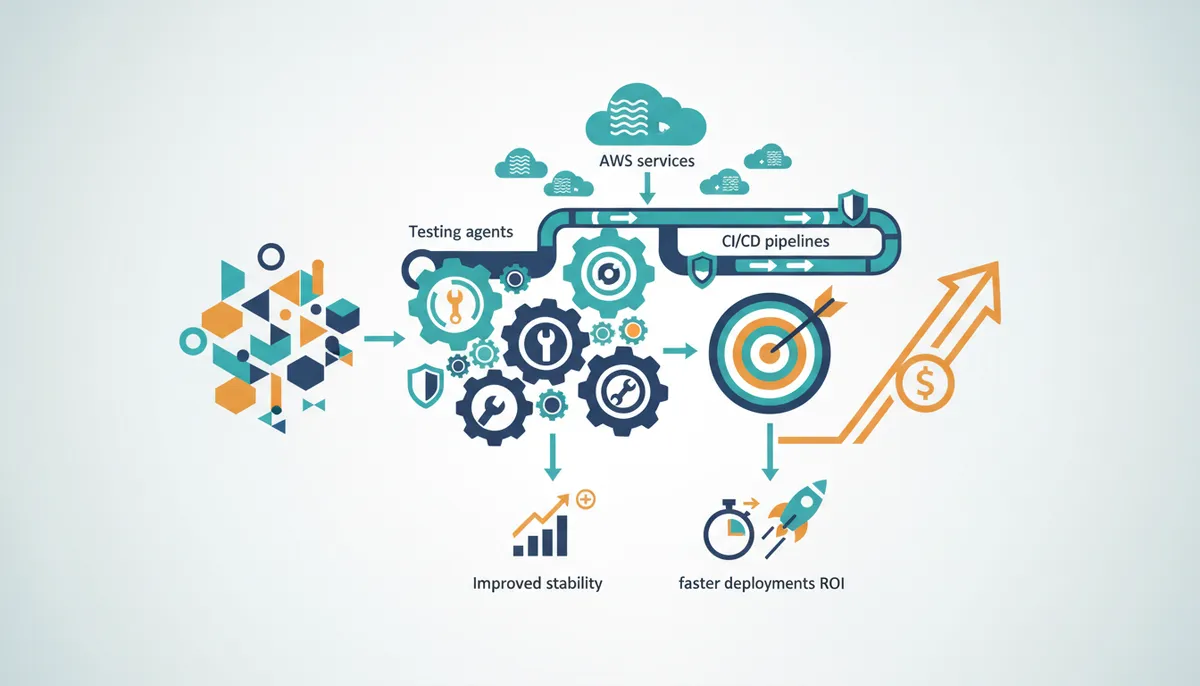
Engineers configure evaluation hooks inside the agent-evaluation framework to launch custom integration tests. These hooks trigger extra tasks like integration testing while standard operations run. Direct connectivity with Amazon Bedrock, Amazon Q Business, and Amazon SageMaker lets teams verify tool-use accuracy before deployment. Embedding these checks shifts organizations from ad-hoc testing to automated workflows in their CI/CD pipelines.
Custom logic complexity affects the overall evaluation workflow even as hooks enable deep service validation. Developers balance granular assertion depth against the need for rapid feedback loops in continuous integration. Static rule engines cannot match how these hooks use generative capabilities to assess multi-turn dialogue consistency alongside API response correctness. Testing protocols now validate both the reasoning layer and underlying action execution simultaneously. Production environments gain stability through this dual validation.
Accelerating Delivery Stability in Production CI/CD Pipelines
Build pipelines reduce deployment risk by automating regression checks before code reaches production using the agent-evaluation framework. An internal evaluator agent stress-tests a target model by executing concurrent, multi-turn conversations. This orchestration finds reasoning failures that static unit tests miss, ensuring new tool definitions do not break existing interaction patterns. Teams define custom hooks to validate specific AWS services integrations, such as verifying tool schemas for Amazon Bedrock or SageMaker endpoints. Validation shifts left, allowing engineers to detect performance degradations immediately. Conversational evaluations require significant computational resources, necessitating strategic scheduling within the pipeline.
Operational stability depends on balancing evaluation depth with pipeline latency. Thorough testing improves reliability, yet excessive evaluation time can bottleneck release cycles, requiring teams to tier their test suites by criticality. Developers configure the evaluator to run specific suites based on their delivery stage. Velocity remains high without sacrificing the rigor needed for complex agentic systems.
Adopting the Framework: Components, Hooks, and Release Status
What Continuous Validation Replaces
Continuous validation replaces ad-hoc checks with a structured workflow for testing virtual agents. The framework implements an LLM agent, referred to as an evaluator, which orchestrates conversations with a user's agent, known as a target, and evaluates the responses during the conversation. This approach enables the orchestration of concurrent, multi-turn conversations that static rule-based systems cannot replicate. The framework includes built-in support for popular AWS services, specifically Amazon Bedrock, Amazon Q Business, and Amazon SageMaker, while also allowing users to bring their own agent to test.
| Component | Function |
|---|---|
| Evaluator | An LLM agent that orchestrates conversations and evaluates responses |
| Target | The user's agent being tested by the framework |
| Hooks | Perform additional tasks such as integration testing |
These hooks allow teams to integrate custom integration testing tasks alongside standard conversational flows. Documentation for the process resides at awslabs.github.io/agent-evaluation/, guiding users through the initial setup phases.
Repository Layout and Hook Configuration
The repository includes standard files such as requirements.txt, requirements-dev.txt, pyproject.toml, and setup.py to manage project configuration and dependencies. The framework enables operators to define hooks that execute custom logic during evaluation cycles. These hooks enable integration testing by performing additional tasks alongside the evaluation of conversational flows.
Unlike static rule checks, this approach handles the complexity of conversational state across multiple turns. The project is hosted under the awslabs organization and is licensed under the Apache-2.0 license.
Release Status and Community Traction
The latest release is version v0.4.1, published on Mar 31, 2025. The repository has received 368 stars and has been forked 50 times, indicating active community interest in this approach to agent testing.
Planning the pipeline follows from that: automated execution of evaluation suites supports production stability, yet every run orchestrates concurrent, multi-turn conversations, so the budget has to cover evaluator load and not only target latency.
About
Diego Alvarez serves as a Developer Advocate at AI Agents News, where he specializes in hands-on build guides and rigorous framework comparisons. His daily work involves constructing agents with tools like CrewAI and LangGraph while benchmarking coding agents against real-world failure modes. This direct experience makes him uniquely qualified to dissect the agent-evaluation framework from awslabs. Having tested countless orchestration patterns, Diego understands the critical need for reliable evaluation mechanisms that go beyond simple prompt engineering. At AI Agents News, his mission is to help engineers distinguish between marketing hype and production-ready utility. By using his background in developer education and end-to-end agent construction, he connects the technical specifics of this AWS-powered framework to the practical challenges builders face when validating LLM agents. His analysis ensures readers grasp not just how the tool functions, but how it solves genuine reliability gaps in autonomous systems.
Conclusion
Static scripts can tell you that an agent failed. They cannot tell you whether it misread the prompt, planned badly, or called the right tool with the wrong arguments, which is why a single pass/fail score stops being useful the moment conversations run past one turn. An LLM evaluator that drives the target through concurrent dialogue and scores reasoning separately from action turns that one ambiguous signal into a component-level diagnosis.
The cost is worth naming plainly: an evaluator agent running alongside the target consumes compute, adds latency, and lowers throughput as concurrency grows. That is the trade, depth of insight against execution speed. Hooks keep it honest by grounding generative judgments in deterministic checks on schemas and tool calls, and tiering suites by criticality keeps the evaluation from becoming the bottleneck it was meant to remove.
Frequently Asked Questions
The codebase is predominantly Python, ensuring high extensibility for users. This language constitutes 96.2% of the total source code, allowing developers to easily write custom hooks and integrate their own agents.
Dynamic evaluation assesses the reasoning layer that static scripts miss entirely. A fixed string match cannot separate a planning error from a transient API fault, while an evaluator running multi-turn dialogue scores reasoning and action independently and names the component that failed.
The system orchestrates concurrent multi-turn conversations to validate stateful behavior. An evaluator agent holds the session state while it interacts with the target, so logic that depends on history rather than isolated inputs gets tested as it actually runs.
Yes, the framework integrates directly into CI/CD pipelines, so regression detection happens on code commit. Custom hooks run integration tests in the same pass, verifying function schemas before deployment rather than after an incident.
Native support exists for Amazon Bedrock, Amazon Q Business, and Amazon SageMaker. Users can also bring their own agent as the target, which keeps the evaluator usable outside that stack.