Agent framework choices: Vellum vs Mastra
Eleven frameworks now define the production environment for building autonomous systems, forcing developers to choose between heavy orchestration engines and specialized personal assistants. Vellum delivers immediate utility with persistent memory across multiple surfaces, while Mastra and LangChain dominate complex multi-agent workflows. The trade-off between managed services and open-source libraries decides whether a team ships in days or spends weeks on plumbing. The analysis reveals why single-developer teams favor pre-wired runtimes while enterprise deployments still rely on modular ecosystems for agent-to-agent collaboration.
The guide evaluates top contenders including AutoGen and the OpenAI Agents SDK against strict criteria for observability and deployment speed. Data from the original research by Nicolas Zeeb highlights how modern tools like Mastra support over 40 model providers out of the box. Stop building glue code and start shipping reliable workflows by understanding which architecture actually fits your stack.
The Role of AI Agent Frameworks in Modern Development
AI Agent Frameworks as Boilerplate Eliminators
An AI agent framework does more than organize code; it replaces the weeks of manual plumbing required to wire persistent memory layers and RAG pipeline construction. These toolkits supply pre-built architectures enabling autonomous goal-directed behavior, a capability separating them from standard chat interfaces. By abstracting the heavy lifting, developers immediately shift focus from writing glue code for Mac, iOS, or Slack connectors toward defining business logic.
Category leaders like Mastra and AutoGen manage complex multi-agent coordination, whereas personal assistant frameworks like Vellum provide pre-configured runtimes with seven native surfaces. This modularity lets teams swap components without rewriting core orchestration logic. However, this abstraction creates a dependency on the framework's specific governance model, potentially limiting custom audit logging in highly regulated environments. Teams must decide if the speed of pre-wired surfaces outweighs the need for granular control over runtime traces. Framework choice dictates the ceiling for agent complexity. Selecting a visual builder over a code-first SDK accelerates initial prototyping but often restricts implementation of custom evaluation loops required for production stability.
Shipping Operator-Level Assistants with Vellum
Vellum removes the barrier to entry for shipping a single operator-level assistant. Because the runtime, memory, and surface fan-out are pre-configured, teams ship in days rather than the weeks required for custom builds to wire tool calls and deployment targets. This open-source personal AI assistant delivers a working agent on day one. The framework includes persistent memory to retain context across sessions, solving the statelessness plaguing basic chat interfaces.
Seven native surfaces arrive ready for use, covering Mac, iOS, web app, voice, email, Telegram, and Slack. Separate integrations for each endpoint become unnecessary. Developers extend functionality by encoding specific workflows as skills in Python or TypeScript rather than managing infrastructure.
This model suits single-agent roles best. Attempting to force complex multi-agent collaboration into this simplified runtime introduces friction better avoided by selecting a dedicated orchestration engine. Builders must match the framework to the actual deployment target.
LangChain vs Vellum: Multi-Agent Orchestration vs Day-One Deployment
An AI agent framework acts as the orchestration layer removing boilerplate for memory and tool calls. Selection depends entirely on the deployment target rather than raw feature density. LangChain serves complex multi-agent production systems requiring granular control over state machines. Vellum delivers a functional assistant immediately by pre-wiring seven native surfaces. This distinction creates a fork in architectural strategy: custom plumbing versus pre-configured runtime.
Teams building for FP&A or Data Science often prioritize speed over modularity. Mastra bridges this gap with TypeScript-native workflows for web developers. Choosing a general-purpose engine for a simple task introduces unnecessary latency and maintenance overhead. The cost of flexibility is measured in the weeks spent wiring tool calls before the agent earns its keep. Operators must recognize that observability requirements differ between single-agent pilots and coordinated swarms. While 90% of enterprises rely on open-source software, the operational burden of self-hosting complex orchestration logic remains high. The optimal path matches the framework to the endpoint, avoiding the trap of over-engineering a solution for a problem that does not yet exist.
Inside the Architecture of Observable Agent Orchestration
Defining Modular and Observable Agent Architecture
Reliable orchestration engines replace fragile custom plumbing by delivering modularity, observability, and governance. Swapping memory backends or model providers without rewriting core logic defines modularity. This architectural choice supports the shift toward complex multi-agent orchestration where coordinated systems must evolve independently. Logs, traces, and evaluation tools provide the observability needed to debug failure modes in production environments. Diagnosing why an agent loop diverged remains guesswork rather than engineering without these signals. Adding deep governance features such as RBAC and audit trails often raises the total cost of ownership notably. Strict compliance needs compete against the agility required for rapid iteration. Production readiness comparisons in 2026 explicitly include Total Cost of Ownership (TCO) as a defining parameter. Hidden costs of orchestration and maintenance act as significant differentiators.
| Feature | Definition | Operational Impact |
|---|---|---|
| Modularity | Swappable components | Reduces vendor lock-in risk |
| Observability | Logs and traces | Enables root cause analysis |
| Governance | RBAC and audit logs | Meets regulatory compliance |
Open-source software powers most production workloads now. Few frameworks offer both code-first SDKs and visual builders. This gap forces teams to choose between developer control and operational speed. Treating workflow state as a first-class citizen rather than an ephemeral byproduct supports production readiness.
Scaling from Single-Agent Pilots to Coordinated A2A Systems
Isolated pilots give way to dozens of coordinated systems using standards like Salesforce and Google's Agent-to-Agent (A2A). Single-threaded prototypes lack the multi-agent orchestration capabilities this transition demands. Frameworks like AutoGen enable these complex collaboration loops. Adaptive system behaviors emerge beyond simple prompt-response chains. The market fragmented rapidly over the last six months. A "big three" conversation evolved into an environment where every substantial lab ships its own framework.
| Feature | Single-Agent Pilot | Coordinated A2A System |
|---|---|---|
| Memory Scope | Local Context | Distributed State |
| Governance | Developer Discretion | enforced RBAC |
| Integration | Manual Glue Code | Standardized Protocols |
Accessing the modularity required for serious production environments demands deploying LangGraph v0.2 or higher. Rapid prototyping speed conflicts with the strict governance required for audited deployments. Visual builders accelerate initial design. Code-first approaches remain necessary for implementing custom safety filters. Unmanaged state divergence poses the primary architectural risk as agent networks expand. Tracing failure paths across dozens of interacting agents becomes impossible without centralized observability. Teams relying on custom plumbing rather than standardized frameworks face exponentially higher maintenance costs. AI Agents News recommends prioritizing frameworks with native evaluation tools to mitigate these coordination failures before they impact production stability.
Version baselines carry as much weight as feature lists here: CrewAI versions v0.86 and above represent the current baseline for production-ready features, and the split between "learning and research" frameworks and enterprise ones implies the former lack the stability paid production requires. The Claude Agent SDK sits at the other end, categorized as a premium option for organizations with significant resources and complex requirements.
Vellum vs Mastra and open-source vs Managed Trade-offs
Vellum vs Mastra: open-source Personal Assistants vs TypeScript Agent Frameworks
Vellum hands developers a working agent on day one, complete with persistent memory across seven native surfaces. Mastra takes a different path, offering a modular TypeScript framework designed for custom agent logic. This split separates operator-level assistants from full-stack web integration. Vellum targets teams needing immediate functionality with skills written in Python or TypeScript. Mastra requires building the runtime environment but grants deep control over workflows and RAG. Comparative analyses of this market judge orchestration, observability, and production readiness rather than raw feature counts. The choice hinges on whether the goal is a personal assistant or a distributed system component.
| Feature | Vellum | Mastra |
|---|---|---|
| Primary Runtime | Native Mac App / Cloud | Node.js / TypeScript |
| Surfaces | 7 Native (iOS, Slack, etc.) | Custom (Next.js, Express) |
| Best For | Operator Assistants | Web-Native Agents |
| Pricing | $50/mo (Pro) | $250/month (Teams) |
Teams prioritizing speed for single agents avoid the plumbing required by general-purpose libraries. Mastra's TypeScript-native approach eliminates the friction of maintaining separate Python microservices for web teams. A constraint exists: Vellum's pre-wired surfaces constrain deployment to its supported channels. Mastra demands configuration for every output target. Builders must decide between immediate utility and architectural flexibility. AI Agents News recommends Vellum for single-operator tools and Mastra for full-stack engineering teams: match the framework to the endpoint, not to the underlying model capabilities.
Managed Frameworks Like Mastra Versus Code-Only Stacks Like LangChain for Production
Managed platforms accelerate deployment by bundling evals and tracing. Code-first stacks demand manual infrastructure assembly. Teams selecting a framework face a binary choice between operational speed and architectural control. Managed frameworks like Mastra include built-in evaluation and memory primitives that eliminate weeks of plumbing for TypeScript developers. In contrast, code-only stacks such as LangChain offer modular flexibility but require engineers to self-host observability backends and manage versioning logic. The cost of this flexibility is measurable: teams using modular libraries often delay auditability until governance failures occur.
Long-term maintenance conflicts with initial velocity. Managed services reduce upfront toil but introduce vendor lock-in for agent workflows. Open-source libraries avoid this ceiling but transfer the entire burden of runtime stability to the operator. Teams must weigh the entry price of modular tools against the hidden engineering hours required to match managed reliability. Selecting the wrong architecture early forces a costly migration once agent complexity scales beyond simple prototypes.
Deploying Production Agents with TypeScript and Human-in-the-Loop Controls
Mastra's TypeScript Human-in-the-Loop Architecture
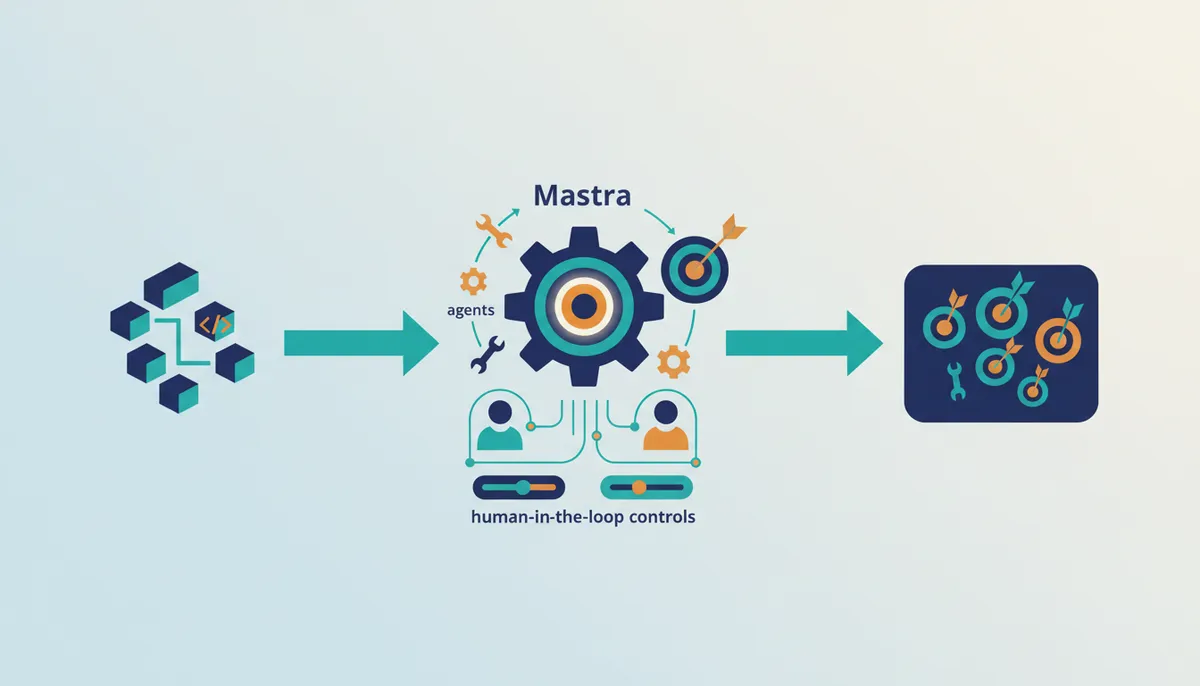
Mastra integrates approval gates directly into agent execution flows to define human-in-the-loop controls. This open-source TypeScript framework combines agents, memory, and evals for safe autonomy management. Developers configure these primitives to pause workflows for manual review before sensitive tool calls execute. The system routes requests across 40+ model providers while maintaining state consistency during interruptions.
| Component | Function |
|---|---|
| Approval Gates | Halts execution for manual sign-off |
| Memory | Persists context across pause states |
| Evals | Validates outputs before continuation |
By early 2026, production readiness, orchestration, and observability became the primary filters for selection rather than raw experimental features. Mastra addresses this shift by prioritizing observable workflows over experimental capabilities. A TypeScript-only environment limits interoperability with Python-heavy ecosystems. Teams gain precise control over agent actions but must accept a younger system with fewer pre-built integrations. This architecture forces explicit definition of failure modes rather than relying on implicit model behavior. Operators can deploy these guarded agents wherever Node.js runs, avoiding vendor lock-in while enforcing strict governance policies on every interaction.
Deploying Node.js Agents with Mastra Studio and Evals
Initiate deployment by cloning the repository and running the local development server to access Mastra Studio. This interface visualizes agent execution traces, allowing engineers to inspect state transitions and token usage without configuring external telemetry backends. Unlike other solutions requiring manual instrumentation for similar visibility, Mastra bundles these observability primitives natively within the TypeScript runtime. Teams prioritizing Total Cost of Ownership often favor this integrated approach to avoid the hidden maintenance expenses associated with disjointed monitoring stacks. Developers define tool calls using Zod schemas to enforce strict input validation before any function invocation occurs.
Production Readiness Checklist for TypeScript Agent Stacks
A validated deployment requires verifying that the chosen framework supports persistent state management and native evaluation tools. Engineers must confirm the system handles human-in-the-loop pauses natively to ensure smooth operator intervention. The cost often involves accepting specific system constraints to avoid building custom audit trails from scratch.
| Feature | Requirement | Risk if Missing |
|---|---|---|
| Model Routing | Supports 40+ providers | Vendor lock-in |
| Tracing | Built-in UI for execution logs | Blind spots in failures |
| Evaluation | Automated output scoring | Silent degradation |
Research-grade options offer free access yet frequently lack the governance controls required for enterprise audit compliance. Many open-source projects rely on community plugins for critical security features like RBAC. Developers building on similar orchestration layers must explicitly verify versioning strategies for agent definitions. Securing versioning controls prevents drift between development and production behaviors. Validating these four pillars is necessary before committing to a specific vendor runtime.
About
Priya Nair serves as AI Industry Editor at AI Agents News, where she tracks the business dynamics behind autonomous systems and coding agents. Her daily work analyzing product launches, funding rounds, and platform shifts for tools like Devin and Claude Code uniquely positions her to evaluate the current AI agent framework environment. Unlike pure engineering guides, this article reflects her deep understanding of how market forces and vendor strategies influence framework viability for production use. By connecting real-world adoption trends with technical capabilities, Priya helps engineers navigate the distinction between hyped prototypes and stable, production-ready tools. Her coverage at AI Agents News ensures this comparison remains neutral, focusing on orchestration reliability and multi-agent coordination rather than marketing claims. This perspective is critical for technical leaders deciding which frameworks to standardize on, ensuring their infrastructure choices align with both current technical merits and long-term industry trajectories.
Conclusion
The choice between Vellum, Mastra and LangChain is decided by the endpoint, not by feature counts. Vellum ships an operator-level assistant on day one with persistent memory and seven native surfaces, and its price is deployment confined to those channels. Mastra and LangChain hand engineering teams control over workflows, state machines and RAG, and their price is the weeks of plumbing plus the observability, governance and versioning work that nobody bundles for them. Cheap entry points mask that second bill: RBAC, audit trails and persistent state arrive later, as engineering hours.
The four pillars that decide the size of that second bill are model routing, tracing, evaluation, and versioning. A framework that needs external plugins for execution logging or versioning control has not removed that work but deferred it, and the deferral surfaces as silent degradation once agent definitions drift between development and production.
Frequently Asked Questions
It leaves out the engineering hours. Open-source libraries hand runtime stability, self-hosted observability and versioning logic to the operator, so teams pay in maintenance what they save on the license.
Approval gates halt execution for manual sign-off, memory persists context across the pause, and evals validate outputs before the run continues. The constraint is the runtime itself: it routes across 40+ model providers but stays TypeScript-only, so Python-heavy stacks lose interoperability.
Approximately 90% of enterprises rely on open-source software, yet that dominance is not a recommendation by itself. The operational burden of self-hosting complex orchestration logic stays with the operator, which is what turns a free license into engineering hours for observability, RBAC and audit trails.
Vellum's Pro tier costs $50 per month and targets operator assistants; Mastra's Teams tier costs $250 per month and targets web-native agents. The $50 buys the pre-wired side: persistent memory and seven native endpoints without integration work.
Vellum for single-operator tools, Mastra for full-stack engineering teams. The dividing line is the endpoint rather than model capability: Vellum's pre-wired surfaces confine deployment to its supported channels, while Mastra demands configuration for every output target but runs wherever Node.js does.
References