Plain language onboarding boosts agent completion rates
Describe the workflow you need in plain language, and the Onboarding Assistant drafts the agent role, the behavior instructions and an approval flow for you to check. Nothing exists until you approve that draft; only then does the assistant open the workspace channel, add the agent and set the recurring routine that keeps posting output for the team.
Separating the drafting of instructions from their execution is what keeps agent collaboration scalable: the system absorbs the setup work, the human keeps decision-making power over what actually gets created.
The Role of Plain Language Interfaces in Modern Agent Creation
Vokal Onboarding Assistant Definition and Role Drafting
Most AI agent demos skip the messy part. They start once the configuration is done, the role is written, and the tools are connected. Vokal starts earlier by tackling the setup phase directly. The Vokal Onboarding Assistant lets a user describe a needed workflow using plain language instead of code. This tool translates those descriptions into executable agent roles, behavior instructions, and approval flows. It parses natural language requests to draft specific components like role constraints and operational boundaries before any code executes.
Rapid configuration happens because the system generates a draft approval flow requiring human validation. This gating mechanism means the setup work is automated, yet the operator decides where an agent operates. The human retains decision-making power regarding what gets created.
Precise definitions drive the agent handoff capability across multiple autonomous entities. The structural shift from trigger-action scripts to AI agent platforms means plain language now defines the orchestration logic rather than just the trigger condition.
Inside the Conversion of Natural Language Requests to Executable Workflows
Where Generated Roles Break Down
Industry analysis indicates that CrewAI excels in role-based multi-agent crews, which validates prioritizing role clarity during generation. A tension persists between fast deployment and behavioral precision. Overly broad natural language inputs create agents with ambiguous behavior instructions needing iterative refinement. Multi-stage environments demand distinct role separation to prevent task collision. Statistics show that 57% of organizations already apply agents for multi-stage workflows, increasing the necessity for rigorously set roles at creation. The assistant isolates role parameters from execution logic so builders audit the agent role independently of tool access. Generated workflows adhere to the intended operational model before entering production channels.
Applying Conversational Onboarding to Boost Completion Rates
Switching to conversational onboarding flows can raise completion rates, particularly in mobile-first applications. This shift eliminates friction from manual YAML configuration by letting engineers define agent roles and behavior instructions through natural language prompts. Traditional setup methods often stall due to syntax errors or complex framework requirements, causing significant drop-off before deployment. Automating the drafting of approval flows keeps human oversight integral without impeding initial progress.
Organizations using agentic AI report reclaiming over 40 hours monthly on routine tasks, with work finishing in minutes rather than days. Parsing plain language requests into structured approval flows governs agent conduct immediately upon creation. Relying on generated configurations requires rigorous validation of underlying behavior instructions to prevent logical drift in production environments. Natural language parsing may misinterpret detailed security constraints if the initial prompt lacks specific boundary definitions. Builders automate agent workflows when task repetition is high but must verify that the generated approval flow explicitly includes human gating for sensitive operations. Setup transforms from a barrier into a catalyst for rapid iteration.
Validating the Human Approval Step Before Execution
The workflow activation sequence halts at a mandatory approval gate where humans verify drafted role definitions before execution begins. This checkpoint stops unvetted automation from accessing production tools, ensuring generated behavior instructions align with organizational safety policies. The Onboarding Assistant constructs initial logic, yet the operator must explicitly authorize the transition from draft to active status.
Gartner predicts that 40% of enterprise applications will embed task-specific AI agents by the end of 2026, up from less than 5% in 2025. This surge increases the surface area for configuration errors, making human validation necessary rather than optional. Frameworks like LangGraph model these processes as directed graphs, yet they still require explicit human confirmation on edge cases where branching logic might fail. Unverified agents may execute incorrect actions at scale before detection. Builders treat the approval step as a hard dependency, not a suggestion: review the drafted behavior constraints against potential prompt injection vectors and confirm that the approval flow explicitly gates channel creation. AI Agents News recommends enforcing this manual check to balance speed with reliability in high-stakes environments.
Execution Protocols for Approval Flows and Recurring Task Automation
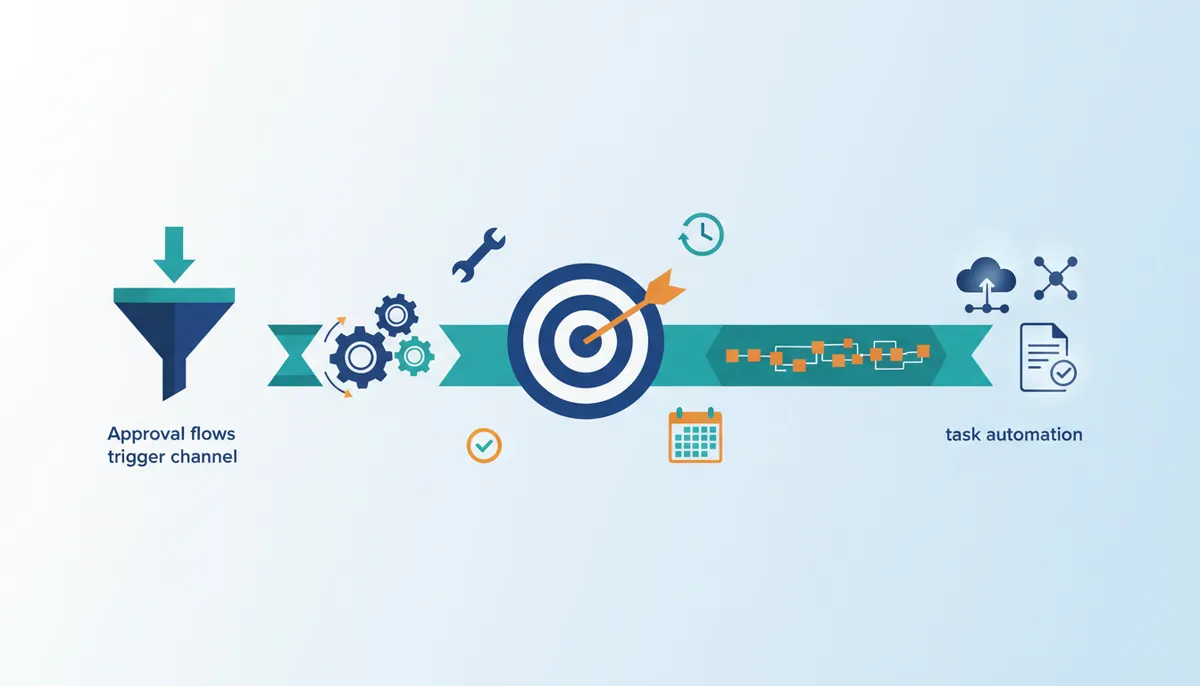
Human authorization is what triggers creation: the Onboarding Assistant instantiates the workspace channel named in the approved configuration, adds the agent entity to it and switches on output posting. It then establishes a scheduled routine in the provided demo, enabling the agent to automatically repeat tasks and continuously post fresh output. This configuration transforms a one-off execution into a persistent service, ensuring that data updates or status checks occur without manual re-triggering. By automating the temporal aspect of workflow execution, teams avoid the latency inherent in manual initiation cycles. Once the human operator validates the initial plain language description, the system instantiates the loop and the agent posts its output where the team can see and review it. If the underlying data source changes format, the repeating agent may propagate errors at scale. Continuous monitoring of the shared channel becomes necessary to catch divergence early.
Strategies for Enabling Smooth Agent-to-Agent Collaboration
Shared Channels as the Foundation for Agent Handoffs
Manual context copying disappears when a second agent pulls the first agent's output directly from a shared channel to start the next workflow step. This shared channel functions as the specific zone where agent handoffs occur, letting a downstream persona grab raw text immediately. Humans stop moving data between isolated chat windows. These spaces merge tasks, documents, and memory into one surface everyone sees. A planning agent finishes an analysis, and an execution agent grabs that exact output to draft the next move. Vokal's pattern keeps critical transitions auditable by requiring human oversight during these exchanges. Fragmentation happens when teams scatter decisions across different tools, and this design fixes that breakage. Session-based models wipe context clean once a query ends, yet this structure holds continuity across distinct phases.
Complexity rises in the memory structure because agents must tell local context apart from team-level knowledge. Operators manage a flexible workspace rather than simple chains. Every single output becomes a trigger for whatever process comes next, so noisy channels full of irrelevant chatter cost the reading agents their signal, and channel hygiene stops being cosmetic.
Checking That the Approval Gate Fires Before a Handoff
Automated handoffs need validation by confirming human approval gates fire before any secondary agent runs downstream tasks. That check keeps human oversight active while agents swap data inside shared channels.
Visible agent work lets teams audit approval flows before context moves to a second persona. Routines speed up throughput when repeat work gets turned into automated loops, yet skipping the review phase pushes unverified logic into production. Speed conflicts with safety constantly. Rapid iteration tries to skip the friction of human validation. Manual checkpoints stay vital for governance as enterprise apps embed more task-specific AI agents. Builders must view the approval step as the main mechanism for keeping system integrity during complex handoffs rather than a bottleneck.
About
Diego Alvarez serves as Developer Advocate at AI Agents News, where he specializes in hands-on build guides and rigorous framework comparisons. His daily work involves constructing end-to-end agents using tools like CrewAI, AutoGen, and LangGraph, giving him direct insight into the complexities of defining agent roles and orchestration logic. This practical experience makes him uniquely qualified to analyze Vokal's Onboarding Assistant, which aims to translate plain language descriptions into structured agent workflows. By constantly evaluating how different systems handle prompt design, tool use, and failure modes, Diego understands the critical gap between abstract intent and executable instructions. At AI Agents News, an independent hub for engineers building autonomous systems, he focuses on translating technical capabilities into actionable intelligence for developers. His analysis cuts through marketing hype to examine whether such onboarding tools genuinely reduce the friction of agent creation or simply shift the configuration burden elsewhere.
Conclusion
Scaling agentic workflows reveals a critical fracture point: as automation velocity increases, the cost of unverified logic entering production grows exponentially. While 57% of organizations already apply agents for multi-stage workflows, the operational debt of skipping human validation creates fragile systems that fail during complex handoffs. Organizations must treat the approval gate not as a friction point to eliminate, but as the primary mechanism for maintaining system integrity. Relying solely on automated execution without shared context visibility invites catastrophic errors that manual overrides cannot easily fix once the chain reaction begins.
What the Onboarding Assistant moves is the boundary, not the workload: it absorbs role drafting and channel setup, while the decision to create anything stays with the person reading the draft. That trade holds only while the approval gate stays between one agent's output and the next agent's input.
Frequently Asked Questions
Conversational onboarding can raise completion rates, particularly in mobile-first applications. The drop-off it removes is specific: manual YAML configuration stalls on syntax errors and framework requirements, so the setup is abandoned before deployment, while a plain language description hits neither failure.
Organizations using agentic AI report reclaiming over 40 hours monthly on routine tasks, because a scheduled routine repeats without manual re-triggering. The saving carries a condition: if the underlying data source changes format, the same routine propagates the error at the same speed, so the shared channel needs watching.
Because nothing exists until someone approves the draft: the channel, the agent and the routine are created only after that step. The gate is where a person reads the drafted role constraints and operational boundaries, and it is the last point where a prompt injection vector inside those instructions can be caught.
A second agent reads the first agent's output from the shared channel instead of receiving a pasted copy. That makes every output a trigger for the next process, which is also why channel hygiene stops being cosmetic: irrelevant chatter costs the reading agents their signal.
Standard demos begin once the configuration is already done. This one starts at the setup phase itself: role, behavior instructions and approval flow are drafted from a description, and the workspace channel and recurring routine appear only after a person approves that draft.
References