Inventory solutions: Blue Yonder vs o9 for retail planning
Only 7% of retailers run AI inventory at full scale; the blocker is data readiness, not the planning platform.
We move beyond basic demand forecasting to examine how specific platforms like Blue Yonder and o9 Solutions execute real-time inventory optimization. The analysis reveals that successful deployment requires more than just software; it demands a fundamental restructuring of how retail entities perceive and manage physical assets.
Blue Yonder ties planning to execution, o9 Solutions keeps the intelligence in its planning layer, and the flexible pricing, visual search and CRM engines covered below all rest on the same prerequisite: inventory and customer records that resolve in real time. Fragmented, ungoverned data silos sink these initiatives regardless of which platform is chosen.
The Role of AI in Modern Retail Inventory and Demand Planning
Defining AI Inventory Management and Demand Forecasting Platforms
Stock optimization software uses artificial intelligence to balance inventory levels against predicted consumer demand. These systems parse historical sales data alongside external market variables to guide purchasing decisions. Blue Yonder delivers inventory optimization paired with demand forecasting tools, while o9 Solutions provides a similar AI platform explicitly designed for demand planning and supply chain optimization. Functional scope creates the primary distinction between them, and technical architecture reinforces it: Blue Yonder operates on a legacy technology stack compared to newer AI-first competitors. O9 Solutions runs on a modern AI/ML infrastructure built for current data velocities. Operators must weigh planning depth against execution breadth when selecting a vendor.
Adoption Levels and the 7% Implementation Gap
Reported gains trace back to advanced analytics, where systems like Oracle Retail AI support retail inventory and merchandising. Market data indicates a significant majority of retail and consumer packaged goods companies are actively engaged in using or testing AI applications, signaling a shift from pilot programs to production dependency.
The gap sits between interest and operation: only a minority of retailers have fully implemented AI across operations, and just 7% have reached fully scaled deployment. This disparity suggests that while demand forecasting models offer theoretical efficiency, scaling remains a challenge. Operators deploying SAP Integrated Business Planning must account for extensive data requirements before the engines can function accurately. Pricing for these enterprise solutions varies notably: small seat counts are billed monthly, while larger deployments covering supply and fulfillment capabilities move to annual contracts sized by integration needs.
Market Adoption Rates: North America vs Global AI Retail Spend
Global AI retail spend in 2026 concentrates in North America, which is where mature deployment patterns for platforms like RELEX Solutions are most prevalent. While a majority of organizations have incorporated AI into at least one business function, a rise from just over half in 2023, regional maturity varies notably. Operators asking if they should use AI for inventory management must distinguish between global availability and local system support. Gartner projects that by 2027 enterprise applications will increasingly include task-specific AI agents, with supply chain and inventory being leading use cases. While the software is globally available, enterprises must evaluate local data readiness before committing to complex demand forecasting architectures. Success depends on matching tool sophistication to regional data maturity rather than assuming uniform performance.
Inside the Architecture of Flexible Pricing and Visual Search Engines
Defining Flexible Pricing Algorithms and Visual Search Engines
Real-time retail price shifts occur when algorithms ingest competitor data and demand signals to optimize margin. Platforms like Competera execute this task by continuously monitoring market variables, allowing retailers to respond instantly to supply constraints or competitor movements. High-frequency data ingestion powers the mechanism where price elasticity models calculate optimal points without manual intervention.
Visual search engines operate differently by mapping pixel data to product identifiers through deep learning convolutional networks. When a user uploads an image, services like Google Cloud Vision AI extract feature vectors to match inventory SKUs against the query photo. This process bypasses keyword ambiguity, directly linking visual attributes to catalog entries for immediate retrieval.
| Feature | Flexible Pricing | Visual Search |
|---|---|---|
| Primary Input | Competitor prices, demand curves | Image pixels, feature vectors |
| Core Mechanism | Elasticity modeling, rule engines | Convolutional neural networks |
| Latency Sensitivity | Minutes to hours | Milliseconds |
| Infrastructure Load | Database I/O heavy | GPU compute heavy |
The two rows that decide deployment are latency and load: a pricing loop measured in minutes has nothing in common with an image query answered in milliseconds, which is why retail teams run them as separate microservices rather than one monolith.
Implementing Visual Search with Amazon Rekognition and Syte
Visual search pipelines begin by extracting feature vectors from uploaded images to match against indexed product catalogs. This stage converts unstructured visual input into structured metadata tags that downstream systems can query efficiently. Once objects are isolated, platforms like Syte perform semantic matching to retrieve visually similar items from inventory databases without relying on textual descriptors. The mechanism depends heavily on vector similarity scores rather than exact keyword overlaps, allowing discovery even when users lack specific product names.
| Feature | Amazon Rekognition | Syte |
|---|---|---|
| Primary Function | Object Detection | Visual Discovery |
| Integration Scope | AWS System | Retail Specific |
| Data Output | Bounding Boxes | Similarity Rankings |
Generic computer vision models often yield false positives in specialized retail verticals where subtle texture differences define SKU variants. Broad-spectrum detectors may group distinct items together, requiring fine-tuning on domain-specific datasets to achieve acceptable precision. Successful implementation demands a hybrid approach where general object detection feeds into a specialized retrieval engine optimized for commercial aesthetics. Architectural separation ensures that the initial heavy lifting of image analysis does not bottleneck the final user-facing recommendation latency.
Pricefx vs Prisync: Automated Pricing Decisions Compared
Retailers choosing how to use AI for retail pricing must distinguish between internal optimization logic and external competitive monitoring. The definition of flexible pricing varies notably between Pricefx, which executes broad margin strategies, and Prisync, which focuses on competitor price tracking. Pricefx operates as a dedicated optimization engine, ingesting cost structures and demand elasticity to calculate optimal price points autonomously. In contrast, Prisync functions primarily as an intelligence layer, aggregating market data to inform manual or semi-automated adjustments rather than dictating final transaction values.
| Feature | Pricefx | Prisync |
|---|---|---|
| Primary Function | Pricing optimization | Competitor tracking |
| Decision Logic | Autonomous margin calculation | Market position analysis |
| Data Input | Internal costs, demand signals | External competitor URLs |
| Best Use Case | Complex SKU portfolios | Real-time price matching |
Enterprises evaluating these tools face a distinct architectural choice: deploy a system that determines price based on profit goals or one that reacts to market noise. Relying solely on competitor tracking without internal margin guards can trigger race-to-the-bottom scenarios where volume increases but profitability collapses. Tracking data alone does not constitute a pricing strategy; it requires an orchestration layer to convert signals into profitable actions. Validating whether infrastructure needs an optimization engine or a data feed is necessary before committing to either architecture.
Comparing Leading AI Platforms for Supply Chain and CRM Operations
Blue Yonder vs o9: Core AI Inventory and Demand Planning Capabilities
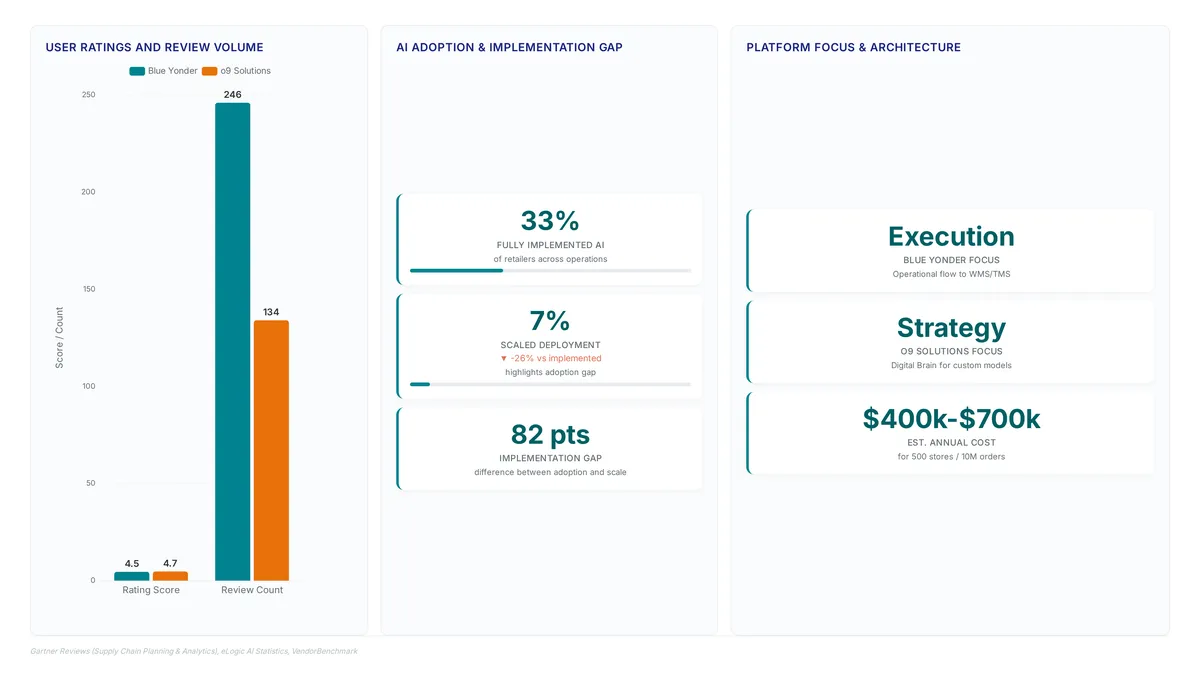
Blue Yonder functions as an AI-powered inventory optimization tool, whereas o9 Solutions operates as a broader strategic planning platform. The difference decides where the engineering work lands for teams evaluating demand planning systems. Blue Yonder, originally JDA Software and now owned by Panasonic, emphasizes direct flow from planning decisions to operational execution systems like WMS and TMS. In contrast, o9 Solutions positions itself as a visionary "AI-powered" planning platform, often favored by large CPG companies for building custom AI-driven models.
| Feature | Blue Yonder | o9 Solutions |
|---|---|---|
| Primary Focus | Operational execution flow | Strategic visibility & decision intelligence |
| Target User | Operations-heavy organizations | Large CPG requiring custom models |
| User Rating | 4.5 stars (246 reviews) | 4.7 stars (134 reviews) |
| Architecture | Integrated execution modules | "Digital Brain" analytical core |
The critical distinction lies in integration depth versus analytical flexibility. Blue Yonder excels where operational execution requires tight coupling with logistics hardware and legacy ERP modules. However, organizations prioritizing complex, multi-variable scenario modeling often find the o9 "Digital Brain" architecture more adaptable to unique business logic. Either way, teams must harmonize data units and timestamps before deployment, or the platform returns forecasts that are mathematically perfect and operationally wrong. Selecting between these vendors depends on whether the engineering constraint is execution latency or model customizability.
Salesforce Einstein and HubSpot Breeze: Deploying AI CRM for Sales Automation
Salesforce Einstein delivers predictive demand forecasting within a unified Customer 360 foundation, whereas HubSpot Breeze AI prioritizes rapid sales automation workflows. The split shows up as an integration bill for retail teams evaluating CRM scalability. Einstein integrates marketing, ecommerce, and POS operations to function from a single shopper context, enabling complex, cross-channel attribution models that disjointed systems cannot support. Conversely, HubSpot Breeze AI offers simplified deployment for mid-market retailers needing immediate sales automation without extensive data warehousing prerequisites. This disparity often stems from underestimating the data unification required for platforms like Einstein compared to the lighter footprint of Breeze. Teams selecting Einstein must account for the engineering overhead of aligning disparate data sources before predictive modeling yields accurate results. HubSpot users may achieve quicker initial velocity but could face limitations in customizing deep learning models for complex supply chain variables. The choice ultimately rests on whether the organization prioritizes immediate workflow efficiency or long-term, data-intensive predictive capabilities.
RELEX vs ToolsGroup: Contrasting Retail Replenishment and Forecasting Engines
RELEX Solutions targets retail replenishment workflows, while ToolsGroup emphasizes demand sensing through probabilistic modeling. Deterministic and stochastic engines fail differently, and that is what teams are actually choosing between in high-velocity SKU environments. RELEX uses deterministic algorithms optimized for shelf-level accuracy, whereas ToolsGroup applies stochastic methods to handle volatility in sparse data streams. The trade-off involves computational overhead versus responsiveness to sudden demand shifts. Teams deploying these platforms must account for the latency introduced by complex probabilistic calculations in ToolsGroup compared to the linear execution speed of RELEX. The limitation for large-scale deployments often lies in the data quality required for stochastic models to outperform simpler heuristics. RELEX fits stable, high-volume categories, while ToolsGroup earns its overhead on erratic demand signals where demand sensing adds measurable value. Future integration efforts will likely focus on hybridizing these engines rather than selecting a single vendor for all use cases.
Implementing AI Solutions for E-commerce Integration and Forecast Accuracy
Wiring Einstein into an Inventory Feed That Lags
Integrating Salesforce Einstein begins by using its AI-powered CRM and customer insights to align shopper context across operations. This architecture ensures marketing, ecommerce, and loyalty data inform every sales automation task without requiring stack reconstruction. Operators minimize integration friction by configuring function calling parameters that allow agents to retrieve order status or modify cart contents directly.
Centralized data improves demand forecasting only as far as the slowest feed allows, and legacy POS systems that never expose real-time inventory counts set that limit. This latency creates a tension where the model recommends products that are physically unavailable, degrading customer trust. Unlike standalone chatbots such as Freshworks Freddy AI which operate in isolation, deep CRM integration requires rigorous API governance to prevent data corruption. The operational cost involves maintaining strict schema validation rather than just tuning model parameters. Builders must prioritize data hygiene over model complexity to avoid compounding errors in automated workflows.
Integration Checklist for Visual Search and Personalization Engines
Validating visual search pipelines requires confirming that image embedding models align with current product catalog metadata to prevent null returns.
- Map image embeddings to existing SKU identifiers to ensure query results resolve to valid inventory states.
- Configure personalization engines like Dynamic Yield to ingest real-time clickstream data rather than relying solely on historical sessions.
| Feature | Visual Search Requirement | Personalization Constraint |
|---|---|---|
| Data Input | High-resolution image vectors | Real-time user events |
| Latency Target | Under 200ms for results | Immediate context update |
| Failure Mode | Empty result sets | Stale recommendation loops |
Model chaining trades latency for recommendation accuracy, and past a point the page load cost arrives without the conversion gain, which is exactly what the latency target in the table is there to catch.
About
Sofia Berg serves as Research Editor at AI Agents News, where she specializes in translating complex multi-agent research into actionable insights for engineering teams. Her expertise in evaluation frameworks and agentic planning provides the rigorous analytical lens necessary to assess AI tools for inventory management in retail and wholesale trade. While many vendors claim autonomous optimization, Berg's daily work involves dissecting benchmark results and methodological limitations to separate genuine capability from marketing hype. This article reflects that disciplined approach, offering a neutral catalog of software solutions without endorsing specific third-party platforms. By focusing on architectural merits and functional descriptions rather than promotional narratives, the piece aligns with AI Agents News' mission to equip builders with factual data. Berg's background ensures that even when discussing supply chain applications, the analysis remains grounded in technical reality, helping professionals evaluate how these systems might integrate into broader autonomous agent workflows.
Conclusion
Scaling AI inventory management beyond pilot programs exposes a critical fragility in legacy data pipelines that model complexity cannot fix. When real-time sync fails, the operational cost shifts from software licensing to manual intervention, eroding the margin gains promised by automation. Retailers must stop treating data hygiene as a pre-launch checklist item and instead view it as a continuous operational requirement. The gap between early experimentation and full deployment widens when teams prioritize feature breadth over the stability of core transaction flows.
Organizations should mandate strict schema validation for all agent function calls before expanding to new verticals. This approach prevents the corruption of customer records and ensures that inventory optimization logic rests on accurate stock levels. The same requirement shows up at the other end of the stack: image embeddings that no longer resolve to live SKU identifiers return empty result sets, and a personalization engine fed stale sessions recommends what the store cannot ship. Only 7% of retailers run AI inventory at full scale, and the distance to that number is measured in data layers rather than in algorithmic sophistication.
Frequently Asked Questions
Reported gains arrive with full deployment, and only 7% of retailers have reached that stage; the rest sit in pilots where the effect stays unproven. What separates the two groups in this data is data readiness rather than the platform chosen.
Small seat counts are billed monthly, while deployments covering supply and fulfillment capabilities move to annual contracts sized by integration needs. That sizing is the part teams underestimate, because the extensive data requirements these engines carry land inside the integration scope that sets the price.
Only 7% have reached fully scaled deployment, and the constraint named across vendors is fragmented, ungoverned data rather than the planning engine. Harmonizing units and timestamps before deployment is what keeps a mathematically perfect forecast from being operationally wrong.
Global AI retail spend in 2026 concentrates in North America, which is where mature deployment patterns are most prevalent. The practical consequence is that global software availability and local support are separate questions, and regional data maturity decides which of the two limits a rollout.
Market data reports a majority of retail and CPG companies actively using or testing AI applications, without a firm count behind it; the number that is fixed sits at the other end, where just 7% run fully scaled deployments. Across sectors, a majority of organizations now use AI in at least one business function, up from just over half in 2023.
References