Delegation runtime cuts context overhead by 80%
IDC predicts AI copilots will sit inside 80% of enterprise apps by 2027. That density turns loose multi-agent systems into chaos without Delegation Runtime. This architecture enforces strict permission logic. It treats delegation as a controlled tool call, not an abdication of authority. The primary agent keeps final decision power while offloading execution. Ignore this guardrail, and complex workflows devolve into unmanageable clusters of uncontrollable model copies.
Delegation Runtime stops context pollution cold. It isolates specific sub-tasks like security reviews and API checks from the main execution thread. Task packages enable simultaneous execution of independent checks while maintaining a singular, auditable chain of command.
Forrester and Gartner mark 2026 as the shift from experimental pilots to necessary orchestration frameworks. Progress Software's Chief AI Officer calls this the era of governance. The difference between a functional digital co-worker and a security liability is binary: does the system treat sub-agents as disposable executors or autonomous entities? Delegation Runtime ensures local work distributes while global control remains absolute.
The Role of Delegation Runtime in Preventing Context Pollution
Delegation Runtime as Controlled Tool Execution
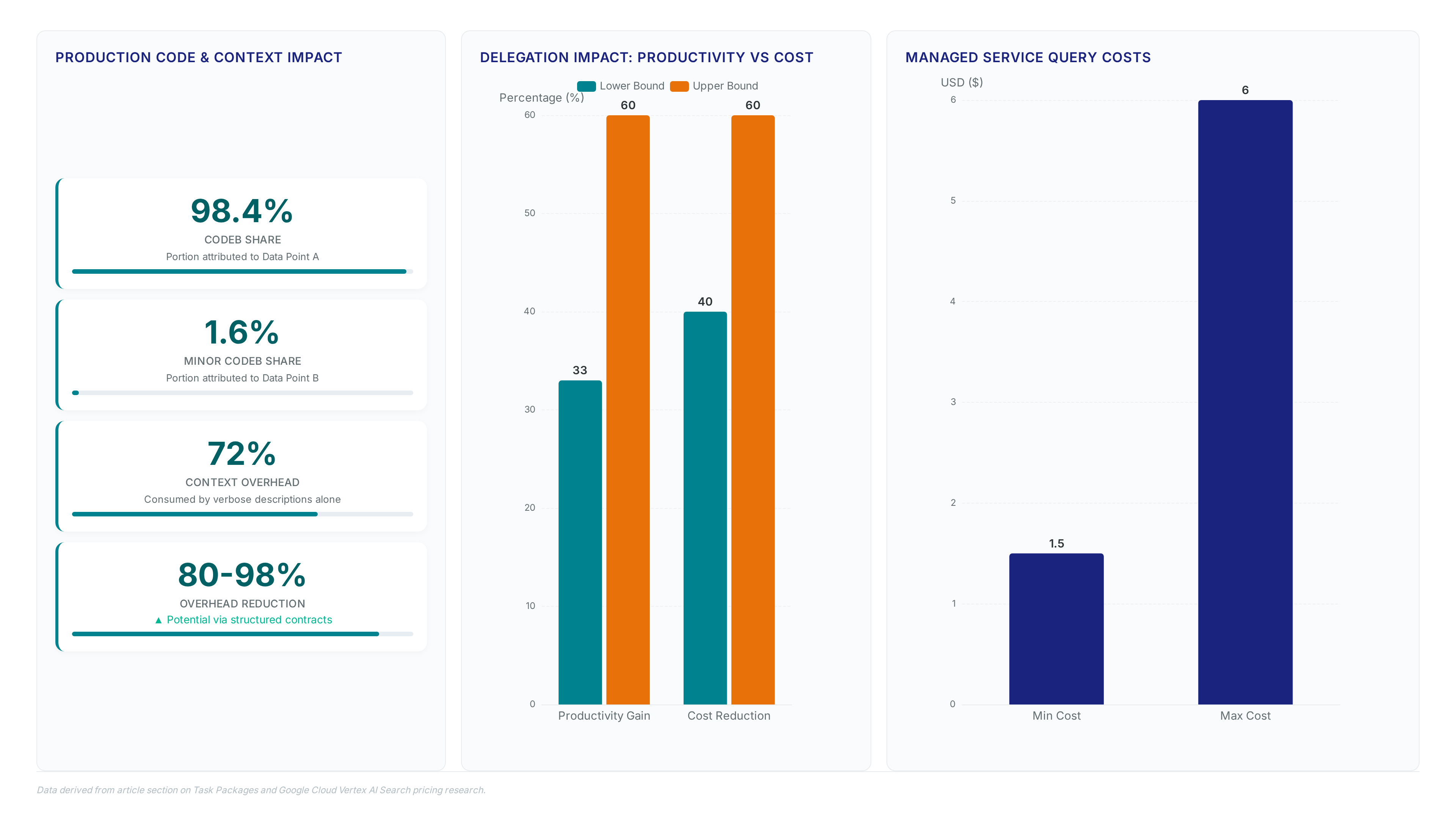
Stop treating sub-agents like duplicated LLM instances. Delegation Runtime isolates exploration noise through structured task packages, not nested model calls. Think tool execution. Simple model copying fails hard because tool descriptions alone consume up to 72% of the context window. That leaves zero room for reasoning or result synthesis.
This architecture enforces permission inheritance. The child agent operates strictly with local exploration rights granted by the parent. Unlike static inheritance models, this design relies on flexible binding to invoke different code segments at runtime based on the specific task package.
Preventing Context Pollution in Complex Test Fixes
Delegation becomes mandatory when local tool execution scatters the main context across unrelated failure paths. A single agent fixing failing tests often loses the primary objective because it performs too many local tasks simultaneously. The parent agent preserves focus by offloading test logs, call chains, and permission logic into isolated sub-agents.
This separation reduces context window overhead by 80% compared to sequential processing within a single thread. Delegate whenever a task requires independent verification steps that do not share immediate state dependencies. Real-world implementations show users coordinating up to two dozen subagents simultaneously for distinct roles like code writing and bug fixing.
There is a catch. Excessive role abstraction in some frameworks incurs a heavier token footprint due to verbose context prepending. Stick to a single agent for linear problems where state continuity outweighs the need for noise isolation.
| Decision Factor | Handle Locally | Delegate to Sub-agent |
|---|---|---|
| Task Structure | Linear, sequential steps | Parallelizable, independent checks |
| Context Load | Low, fits within limits | High, risks pollution |
| Verification | Immediate feedback loop | Requires structured result joining |
Delegation demands strict output contracts. Without them, the parent agent cannot effectively merge conflicting conclusions from child executors.
The First Multi-Agent Trap of Missing Result Contracts
Missing result contracts create unmergeable execution traces that break parent-agent authority. When delegation lacks strict output schemas, the system devolves into chaotic multi-agent role playing rather than structured workflow. CLI agents designed for autonomous multi-file operations require precise return formats to function as tools. Without them, the parent cannot distinguish between a completed task and a hallucinated action.
Frameworks using heavy role abstraction incur excessive token overhead, bloating every call with redundant backstory. Operators skipping validation flows face impossible debugging scenarios when errors propagate up the chain.
Architecture of Controlled Sub-Agent Execution and Permission Logic
Task Package Structure and Context Isolation Modes
The task package mandates explicit fields such as id, role, scope, and contextPolicy to replace ambiguous natural language strings with strict execution contracts. This structure prevents context pollution by enforcing boundaries that simple prompts cannot. The child agent operates as a controlled executor, not an independent actor. Without these explicit constraints, delegation risks inheriting parent bias or exceeding permission scopes, effectively duplicating the original control problem.
| Mode | Inheritance Level | Primary Use Case | Risk Profile |
|---|---|---|---|
| Clean | None (Blank Slate) | Read-only exploration | Misses critical session history |
| Summary | Folded Session Data | Default CLI operations | Potential loss of nuance |
| Fork | Full Context Prefix | Parallel verification | Inherits parent hallucination |
Clean context isolates noise by starting the child with only the task package and necessary facts, suitable for fresh audits. Summary context serves as the recommended default for the CLI Agent, balancing isolation with necessary session data. Fork context inherits the full prefix, useful for verification but dangerous if the parent session contains errors.
Modern implementations like the Hermes Agent use asynchronous toolsets to spawn these packages without blocking the parent interface. Verbose frameworks like CrewAI incur heavy token footprints by prepending role and backstory to every call, whereas concise orchestration layers omit this redundancy.
Enforcing Tool Intersection and Permission Ceilings
The child agent's permission ceiling cannot exceed the parent agent's current control plane. Strict intersection logic prevents capability escalation. This Intersection policy restricts child tools to the overlap between parent capabilities and role-allowed sets, serving as the safest default for untrusted execution. If a delegated role requires a capability the parent lacks, the runtime must return an explainable error rather than silently degrading the task or hallucinating access.
Hermes Agent recently implemented an async_delegation toolset. This architectural choice reflects a broader industry reality where 98.4% of production agent codebases consist entirely of harness infrastructure like permissions, context management, and tool routing.
| Policy Mode | Access Scope | Failure Behavior |
|---|---|---|
| Intersection | Parent ∩ Role | Explicit deny |
| Subset | Role only | Silent drop |
| Isolated | New sandbox | Context reset |
Granting write access to a sub-agent duplicates the parent's risk profile if the permission ceiling is not explicitly capped. Strict intersection reduces flexibility; a child agent cannot dynamically acquire new tools even if the task scope expands mid-execution. Define toolPolicy fields statically within the task package to avoid runtime negotiation failures. The cost of this rigidity is acceptable compared to the alternative of uncontrolled lateral movement within the host environment.
Validating Result Contracts and Evidence Merging
The Join process demands structured outputs like FindingReport or TestReport. Reject natural language essays to prevent context pollution. Uncontrolled sub-agent behavior often stems from ambiguous return types, forcing the parent to parse noise rather than merge evidence.
Validation requires four strict steps before the parent agent decides to continue:
- Map child results directly to the original user goal.
- Verify coverage of all identified key risks.
- Determine if remaining unknowns invalidate conclusions.
- Resolve conflicts between divergent sub-agent findings.
| Contract Type | Data Structure | Merge Logic |
|---|---|---|
| FindingReport | Structured JSON | Evidence accumulation |
| TestReport | Pass/Fail + Logs | Boolean aggregation |
| ReviewReport | Risk Score + Notes | Weighted averaging |
This mechanism functions as evidence merging, not voting. The parent retains final judgment authority. Strict contracts increase initial setup complexity, requiring precise schema definitions for every role. CLI agents excel here because they are designed for autonomous multi-file operations that demand rigid input-output formats. Without this structured approach, the system reverts to uncontrolled copies of the parent model, losing the chain of responsibility entirely.
Implementing Task Packages and Structured Output Contracts
Implementation: Defining the Task Package and Context Policies
Constructing a valid task package requires replacing natural language prompts with a rigid JSON structure containing id, role, and scope fields. This definition prevents the child agent from inheriting parent bias or exceeding permission scopes, effectively solving the control problem where simple prompts fail.
- Define the objective and scope limits to constrain file access and command execution.
- Select a contextPolicy mode ('clean', 'summary', or 'fork') to determine information projection.
- Specify the outputContract to enforce structured data returns like FindingReport instead of text essays.
Selecting summary context balances noise isolation with necessary information, whereas clean modes risk missing critical session history. Verbose role abstraction in frameworks can bloat token usage, creating heavy overhead for every call. Weigh this against cost models where delegated search tasks incur separate billing meters, such as the $1.50 to $6.00 per query range seen in managed services.
The Join process merges evidence rather than voting, requiring the parent to map child results back to the user goal. Strict boundaries prevent chaos but increase coordination latency if the outputContract is too granular.
Implementing Structured Result Contracts for Sub-Agents
Defining a FindingReport with status, checked paths, and confidence levels forces sub-agents to return machine-readable evidence instead of narrative text. This strict schema prevents the parent from parsing ambiguous prose, ensuring that evidence merging operates on discrete data points rather than subjective summaries. Without this constraint, the join process degrades into voting, where conflicting natural language claims obscure the root cause.
Configure distinct contracts for different roles to maintain clarity across parallel executions.
- Assign FindingReport structures to explorer roles for path-based audits containing risks and unknowns.
- Apply TestReport schemas to worker roles, capturing exit codes, failing tests, and environment notes.
Validating the delegation lifecycle requires logging four specific event types, delegation.proposed, delegation.validated, delegation.started, and delegation.tool_call, to reconstruct execution flow accurately. Without these markers, merging parallel traces into a coherent session log becomes impossible, leaving operators unable to audit why a sub-agent deviated from its task package. The session log acts as the central context material library, yet many implementations fail to timestamp tool calls, creating gaps in the forensic record.
- Record delegation.proposed with the full JSON payload to capture initial intent and scope limits.
- Log delegation.validated only after the permission system confirms the intersection policy allows requested tools.
- Emit delegation.started when the child begins work and delegation.tool_call for every tool it invokes, each one timestamped.
Four records, one order: intent, permission, execution, tool use. Miss any of them and the parent cannot tell a skipped step from an unlogged one, which is the moment delegation stops being auditable.
Operational Impact of Event Logging and Session Replay Mechanisms
Event Log as the Source of Truth for Delegation Traces
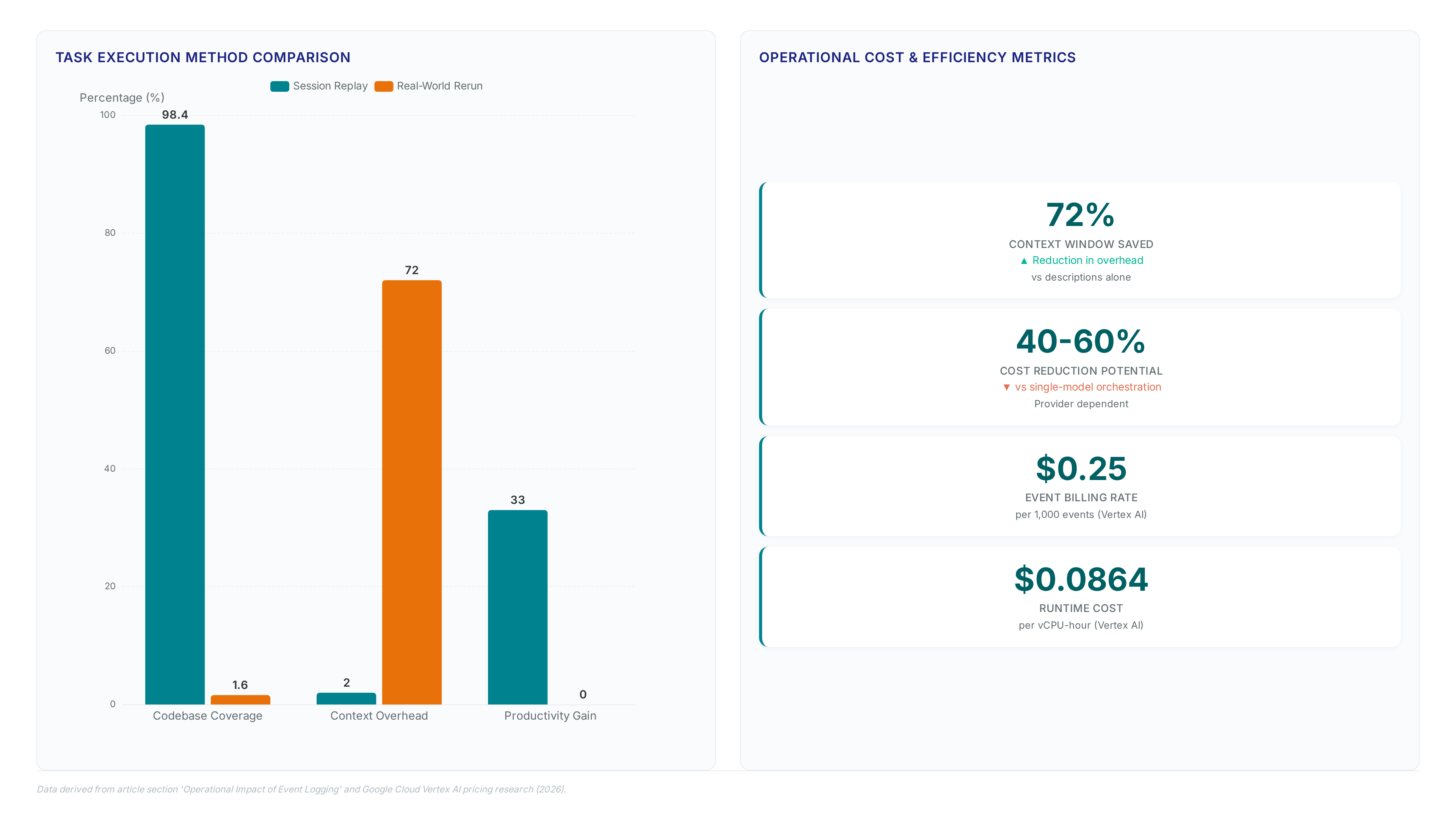
Session replay reconstructs state from delegation.proposed and delegation.started events rather than rerunning the real world. Do not treat sub-agents as conversational threads. The session log serves as the immutable context material library for all delegation traces. Without specific event markers like delegation.validated, the parent agent loses the ability to distinguish between a skipped step and a completed task, fracturing the audit trail. This fragmentation prevents the Delegation Runtime from enforcing permission boundaries or validating output contracts against the original intent.
Replaying session logs restores state from delegation.validated events. Rerunning tasks in production re-introduces exploration noise and variable costs.
| Feature | Session Replay | Rerunning Real World |
|---|---|---|
| Context Source | Immutable event log | Live system state |
| Cost Predictability | Fixed storage fees | Variable compute + API spend |
| Risk Profile | Zero side-effects | High potential for data corruption |
| Debug Speed | Instant restoration | Dependent on external API latency |
Operators avoiding replay mechanisms face compounding expenses when Google Cloud Vertex AI Agent Builder charges apply to every repeated execution cycle. The financial penalty escalates rapidly because billing for Session and Memory Bank events accumulates with each redundant attempt to verify a sub-agent's prior work. Exploration noise in agents refers to the random or iterative queries a model generates while searching for a solution, which pollutes the main context if not isolated. Teams lacking replay capabilities often discard valid partial results, forcing a total re-execution that repeats work the team has already paid for. Security posture degrades significantly when raw secrets are distributed to every new session instead of using OAuth 2.1 for centralized authentication. Without deterministic replay, the parent agent cannot distinguish between a genuine system failure and a transient network glitch observed during the initial run. Enforce strict session log immutability to prevent this costly ambiguity.
About
Marcus Chen, Lead Agent Engineer at AI Agents News, brings direct production experience to the complex challenge of Delegation Runtime. Having shipped multi-agent systems that rely on frameworks like CrewAI and LangGraph, Chen understands the precise breaking points where single-agent architectures fail under context pollution and sequential bottlenecks. His daily work involves evaluating how orchestration layers manage parallel tool use and permission boundaries, making him uniquely qualified to dissect the mechanics of delegating tasks without sacrificing oversight. At AI Agents News, Chen tracks the evolution of autonomous coding agents and framework capabilities, observing firsthand how modern engineering teams struggle to scale beyond simple chat wrappers. This article connects those real-world friction points to the emerging Delegation Runtime pattern, offering a technical solution for maintaining control while using true multi-agent parallelism. His analysis stems from rigorous testing of agent coordination logic, ensuring the guidance provided is grounded in actual deployment scenarios rather than theoretical hype.
Conclusion
Delegation holds only while the parent keeps authority: a scoped task package going down, an intersection permission ceiling in the middle, a result contract the parent can actually merge coming back. Drop any one of the three and the sub-agent turns into another uncontrolled copy of the model, with an event log too thin to prove what it did. As organizations shift from experimental bots to digital co-workers in 2026, the inability to deterministically replay those failures will cripple operational velocity. The bottleneck is no longer model intelligence but the economic friction of validating agent behavior in production environments.
Implement a mandatory session log immutability policy for all autonomous workflows by Q2 2026. This infrastructure change transforms debugging from a variable-cost liability into a fixed-cost asset, allowing teams to isolate genuine system failures from transient network glitches without paying for redundant executions. Relying on live re-runs for verification is an unsustainable tax on your innovation budget that will widen the gap between early adopters and laggards.
Start this week by auditing your current agent orchestration layer to identify which workflows lack replayable event logs. Flag any process that requires a full re-execution to diagnose errors, as these represent your immediate exposure to compounding operational debt.
Frequently Asked Questions
Tool descriptions alone consume up to 72% of the context window. This massive overhead leaves zero room for actual reasoning or result synthesis within the primary agent's execution thread.
Separating local tasks into isolated sub-agents reduces context window overhead by 80%. This significant reduction prevents the main agent from losing focus on primary objectives during complex workflows.
Simple model copying fails because every copy inherits the parent's full tool catalogue instead of a scoped task package. This prevents the system from retaining enough room for actual reasoning or synthesizing results effectively.
The parent offloads test logs, call chains, and permission logic into isolated sub-agents, so unrelated failure paths never reach its own context. It keeps the primary objective and merges only the structured reports the children hand back.
Treating sub-agents as autonomous copies duplicates the parent's full tool catalogue inside every child context. This leads to uncontrollable clusters where the parent loses final decision authority and join control.