Agent image 1.23.1: Why OpenHands locked cloud1.37.1
Commit 0c522c2 forces a hard stop on agent server image drift, locking the environment to version 1.23.1 under the cloud-1.37.1 tag. This isn't housekeeping; it's survival. With Gartner projecting that 40% of enterprise applications will embed task-specific AI agents by the end of 2026, the margin for error in sandboxed executors has vanished. Loose versioning invites interface collapse and security gaps that autonomous workflows exploit instantly.
The release tagged by neubig on June 2 governs how the stateless Agent pushes actions into isolated Docker sandboxes, and pinning the image is what keeps that boundary predictable across tenants. The pivot to a hosted SaaS model on March 31, 2025, is why rigid image hashing became mandatory: a multi-tenant cloud cannot let the orchestration layer and the agent runtime drift apart between sessions.
With 78.1k stars and 9.9k forks pressuring the OpenHands repository, understanding the delta between version 1.23.1 and its predecessors is mandatory for maintaining system integrity in high-volume environments.
Defining the Cloud-1.37.1 Release and Agent Server Image Update
Commit 0c522c2 locked the default agent server image to version 1.23.1 under the cloud-1.37.1 tag via pull request #14612. User neubig applied this change on June 2 at 12:59. Stability improvements target the Docker sandbox execution environment as the system moves past local-only limits.
Automated release artifacts appear because metadata lists Co-authored-by: openhands. This signature separates machine-generated infrastructure updates from human engineering contributions. Support extends to the OpenHands Cloud system, which adopted a hosted SaaS model on March 31, 2025. Strict image versioning maintains consistency across multi-tenant workloads in the cloud rather than local deployments.
Operators separate this cloud-specific tag from standard semantic versions in the Public repository. A pinned dependency chain stops drift between the orchestration layer and agent runtime. GitHub interface loading errors occur during session initialization if versions do not align. Platform integrity takes priority over immediate feature availability under the constraints of managed service operations.
The cloud-1.37.1 revision mandates a modular architecture where a stateless Agent emits Actions inside an isolated Docker sandbox. Arbitrary code commands cannot harm the host system under this design. IDE extensions often lack such restricted environments. First-class Docker runtime support contains these execution loops to protect infrastructure during autonomous tasks.
Madrona led a recent $18.8 million Series A funding round that signals enterprise readiness for scalable isolation patterns. Operators using the new agent server image rely on a Conversation manager to maintain an append-only EventLog while offloading execution to the containerized Workspace.
Latency overhead appears here that local process execution modes avoid. Full shell access within the sandbox boosts security yet demands extra resources for container startup times. Enterprise scales frequently employ Kubernetes for orchestration to reduce these delays across distributed nodes. Developers configure Workspace settings explicitly to balance local speed against containerized safety.
Mechanics of Version Tagging and Release Asset Distribution
GitHub Tag Comparison Mechanics for cloud-1.37.1
GitHub compares the cloud-1.37.1 tag against predecessors by resolving the locked commit 0c522c2 rather than parsing semantic version strings. This mechanism forces the default agent server image to version 1.23.1, ignoring any newer tags present in the registry until the next explicit update. The platform uses a unique hybrid model allowing users to run locally or self-host via Kubernetes Helm charts, a flexibility that complicates simple tag-based rollouts compared to SaaS-only competitors.
- The interface fetches the specific commit hash associated with the tag name.
- Metadata checks verify the agent server image reference matches the hardcoded value in the release manifest.
Operators must manually verify the commit hash before deployment to avoid interface loading errors common in cached environments. AI Agents News recommends auditing these locked dependencies quarterly to maintain compatibility with evolving cloud infrastructure.
Troubleshooting Release Asset Loading Errors in OpenHands
Intermittent interface failures displaying 'Sorry, something went wrong' or 'No results found' indicate transient GitHub loading faults rather than missing release artifacts. Operators encountering these messages while attempting to access the 2 available assets must distinguish between platform outages and local cache corruption. The error string 'Uh oh! ' specifically signals a client-side rendering failure when the browser cannot parse the asset list response.
- Clear the browser cache and hard-reload the repository tags page to force fresh content retrieval.
- Construct the direct asset URL manually if the graphical interface continues showing 'There was an error while loading'.
Developers relying on Gartner projections for enterprise adoption cannot afford workflow interruptions caused by simple UI glitches. Ignoring these loading failures delays access to critical stability patches contained within the agent server image. Such faults do not compromise the Docker sandbox execution model used for agent actions. AI Agents News recommends documenting exact error strings to accelerate support ticket resolution when local troubleshooting fails, and verifying network connectivity to the GitHub API before assuming a server-side outage.
Deployment Models and the Cost of Self-Hosting
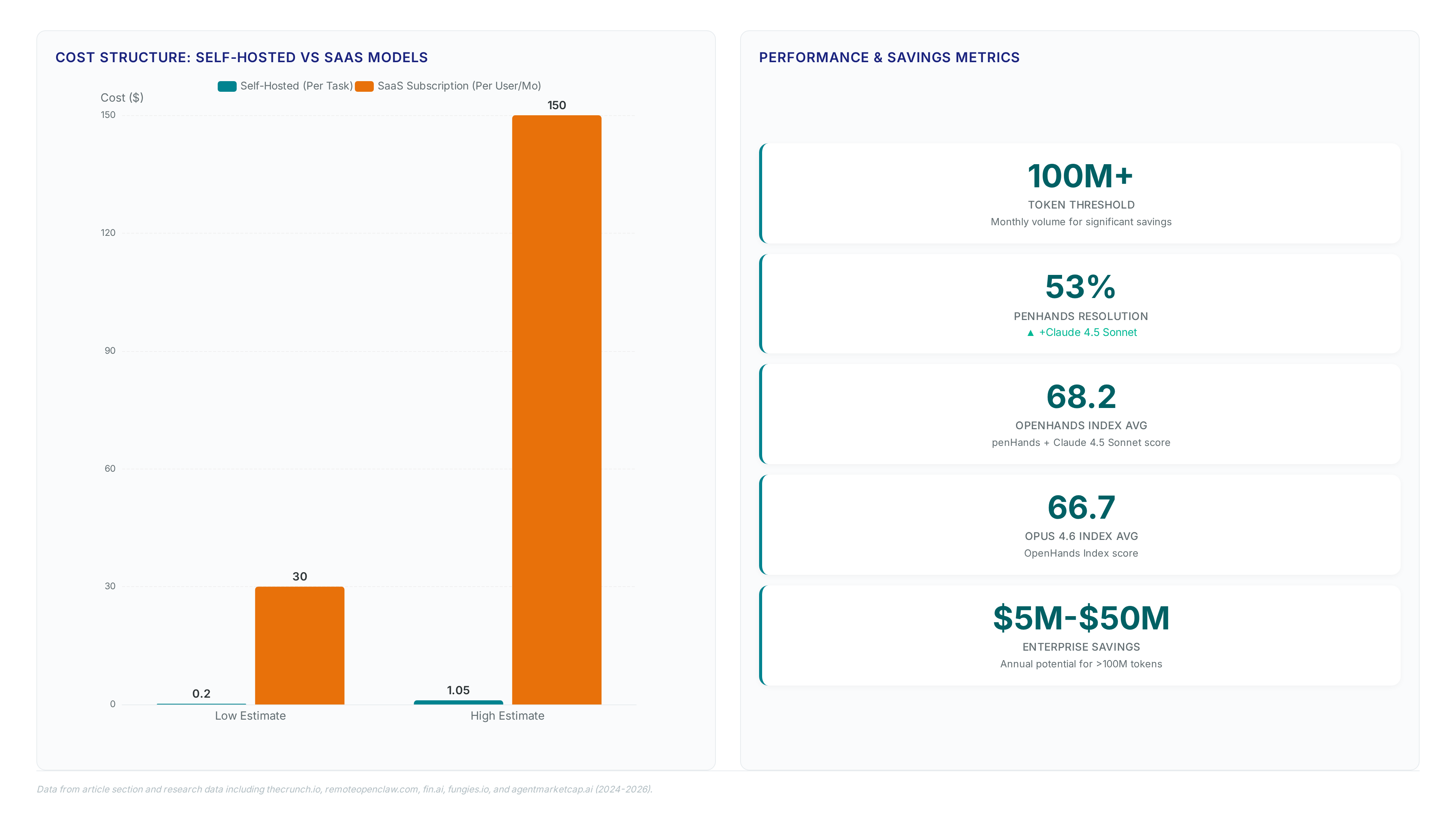
OpenHands supports a hybrid execution model allowing local runs, managed OpenHands Cloud service, or self-hosting via Kubernetes Helm charts. This flexibility distinguishes the platform from SaaS-only competitors like Devin AI, which restrict users to vendor-managed infrastructure. Operators choosing self-hosting gain full control over the agent server image but assume responsibility for GPU provisioning and orchestration complexity. Cost structures diverge sharply between models. Self-hosting on GPU cloud infrastructure using H100 rates incurs variable expenses estimated at $0.20 to $1.05 per resolved task based on spot-to-on-demand rates. This contrasts with subscription-based proprietary models where per-task pricing remains opaque and often higher at scale. Enterprises processing over 100 million tokens monthly realize significant savings by replacing premium API-dependent tooling with this infrastructure-cost-only approach. Operational overhead replaces the simplicity of managed services; teams must manage cluster scaling and image updates manually. Unlike fixed-fee SaaS products charging $30 to $150 per user monthly, the self-hosted model exposes raw infrastructure volatility. Teams lacking DevOps maturity risk unpredicted spend spikes during high-volume agent activity cycles.
About
Marcus Chen, Lead Agent Engineer at AI Agents News, brings deep practical expertise to the analysis of the OpenHands cloud-1.37.1 release. Having shipped production multi-agent systems, Chen intimately understands the critical importance of secure, isolated code execution environments. His daily work involves rigorously evaluating framework updates across the agent environment, making him uniquely qualified to dissect the implications of updating the default agent server image to version 1.23.1. At AI Agents News, Chen focuses on the mechanical realities of orchestration and sandboxing, directly connecting his hands-on engineering experience with the technical needs of builders deploying OpenHands Cloud. This specific update, which refines the Docker sandbox architecture, aligns perfectly with his track record of tracking how fundamental infrastructure changes impact autonomous agent reliability. By bridging the gap between raw release notes and real-world deployment scenarios, Chen provides the technical clarity engineers require when adopting new SaaS offerings for complex coding tasks.
Conclusion
The lock is the point. Commit 0c522c2 pins the default agent server image to 1.23.1 under the cloud-1.37.1 tag, so the orchestration layer and the agent runtime cannot drift apart between sessions, and the interface loading errors that follow such drift stop appearing during session initialization. The pin costs currency: the registry may already hold newer tags, and nothing moves until someone bumps the version explicitly. That is a deliberate trade for a multi-tenant cloud where a stateless Agent emits actions into a Docker sandbox and arbitrary code must never reach the host. Verify the commit hash before deployment and re-audit the locked dependency on a schedule, because a pin nobody revisits eventually becomes the drift it was meant to prevent.
Frequently Asked Questions
Self-hosting replaces fixed monthly fees with raw infrastructure cost. On H100 rates that lands between $0.20 and $1.05 per resolved task, against the $30 to $150 per user monthly charged by fixed-fee SaaS products.
The update locks the default agent server image to a specific commit hash. This prevents accidental upgrades and keeps deployments on a known-good build.
Errors happen when version tags do not align between orchestration and runtime layers. Strict image versioning is required to support the projected 40% of enterprise apps using agents.
The release mandates a modular architecture where agents emit actions inside isolated Docker sandboxes. This design protects host systems from arbitrary code executed during autonomous tasks.
Container startup adds latency that local process execution modes avoid. Full shell access inside the sandbox strengthens security but demands extra resources, which is why enterprise scales lean on Kubernetes to spread the delay across distributed nodes.